

How to improve your arabic speaking skills online a practical guide for all levels
Category: Arabic Focus Keyword: Improve Arabic Speaking Skills Meta Description:
You have been studying Arabic for months. You can read the letters. You understand some grammar. You recognise words when you hear them. But the moment someone asks you to speak, your mind goes blank.
This is one of the most common and most frustrating experiences in Arabic learning. And it happens to learners at every level, from complete beginners to intermediate students who have invested significant time in their studies.
The good news is that this problem is not about ability. It is about approach. Speaking Arabic is a skill that must be trained deliberately and consistently, and this guide will show you exactly how to do that.
Why Speaking Arabic Feels Harder Than Reading It
Reading Arabic activates recognition. You see a word, your brain retrieves the meaning, and you understand. Speaking Arabic requires production. You need to retrieve the word, construct a grammatically correct sentence, apply the right pronunciation and vowels, and deliver it in real time — often while someone is waiting for your response.
These are two very different cognitive processes, and the fact that you are good at one does not automatically transfer to the other. This is why students who score well in written Arabic exercises sometimes freeze completely in conversation.
There is also a psychological barrier. Many Arabic learners are afraid of making mistakes in front of others, particularly when it comes to a language associated with the Quran and Islamic scholarship. This fear of imperfection keeps people silent when they should be speaking.
The solution to both problems is the same: deliberate, consistent, low-pressure speaking practice with real feedback.
The Most Common Mistake Arabic Learners Make
The single most common mistake Arabic learners make is spending too much time on passive learning and not enough time on active production.
Passive learning includes reading textbooks, watching Arabic videos, listening to lectures, and reviewing vocabulary lists. All of these are valuable, but they do not train your speaking muscles. You can spend a hundred hours watching Arabic content and still be unable to hold a basic conversation.
Active production means opening your mouth and speaking — forming sentences, making mistakes, being corrected, and trying again. This is the only way speaking fluency actually develops.
Many learners avoid active production because it feels uncomfortable. That discomfort is a signal that you are in the learning zone, and that is exactly where you need to be.
Daily Habits That Accelerate Arabic Speaking Skills
Building speaking ability is not about occasional marathon study sessions. It is about consistent daily practice, even in small doses. Here are the habits that make the biggest difference:
Speaking to yourself in Arabic is one of the most underrated practice methods. Narrate what you are doing throughout your day — making breakfast, commuting, preparing for work. Even simple sentences like “I am going to the kitchen” or “The weather is cold today” activate your production skills without the pressure of an audience.
Shadowing is the practice of listening to a native Arabic speaker and repeating immediately after them, mimicking their rhythm, pronunciation, and intonation. This is one of the most effective methods for developing natural-sounding speech and it can be done with any Arabic audio content.
Recording yourself speaking and listening back is uncomfortable but extremely valuable. You will notice pronunciation issues, filler words, and hesitations that you were not aware of in the moment. Reviewing your recordings weekly shows you clearly how much you are improving.
Learning phrases in context rather than isolated vocabulary words makes a significant difference to speaking fluency. Instead of memorising the word for “because,” learn it inside a full sentence that you can actually use: “I am studying Arabic because I want to understand the Quran.”
How Live Online Classes Beat Apps for Speaking Practice
Arabic learning apps have their place. They are convenient, they help with vocabulary and reading, and they are easily accessible. But they have a fundamental limitation when it comes to speaking: they cannot listen to you with a human ear and give you nuanced, real-time feedback.
An app can tell you that your pronunciation score is 72 percent. A qualified teacher can tell you that your Ain is coming from too far back in your throat, that your Ra is being pronounced like an English R, and that you are swallowing the ending of your sentences. That specific, targeted feedback is what actually changes how you speak.
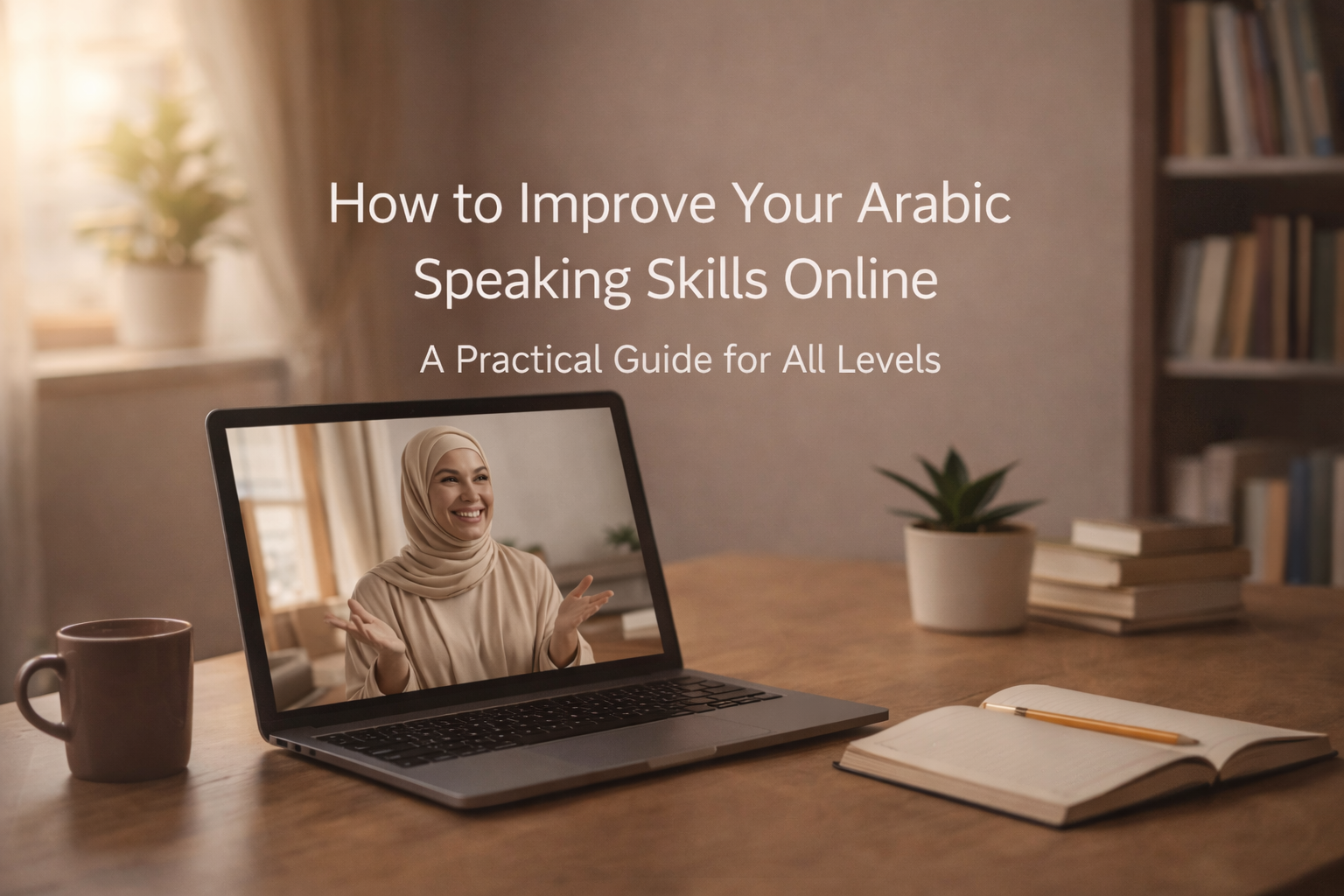
Live one-on-one online classes replicate the most important element of immersive language learning: real conversation with a real person who corrects you, encourages you, challenges you, and adapts to your specific weaknesses. No app can do that.
At Al-Badry Academy, our Arabic Conversation Course is designed specifically for learners who want to develop real speaking ability. Sessions are live, one-on-one, and taught by native Arabic speakers who focus on building your confidence and fluency alongside your accuracy. Our Arabic Classes For Adults also incorporate speaking practice throughout, making sure that students develop all four language skills together rather than treating speaking as an afterthought.
Tools and Resources That Actually Help
Beyond live classes, here are the tools that genuinely support Arabic speaking development:
Arabic podcasts designed for learners, such as those that use slow, clear speech with explanations, are excellent for training your ear and giving you models to shadow. Look for podcasts that use Modern Standard Arabic or the dialect closest to your goals.
Language exchange platforms connect you with native Arabic speakers who want to learn your language. These can provide free conversation practice, though the quality of feedback is naturally less structured than working with a qualified teacher.
Structured vocabulary apps like Anki can help you build the word bank you need to speak more fluently, provided you are learning words in sentence context rather than in isolation.
The most important resource, however, remains a qualified teacher in live sessions. Everything else is supplementary.
Getting Started: Your Arabic Speaking Roadmap
If you are an absolute beginner, the priority is first to build a foundation in reading and basic grammar before focusing heavily on speaking. Al-Badry Academy’s Arabic Grammar Rules Course gives you the structural understanding that makes speaking coherent rather than a random collection of memorised phrases. The Arabic Fusha Course builds your formal Arabic reading and comprehension, which directly feeds into your speaking ability.
If you already have some foundation and are ready to focus on speaking, the Arabic Conversation Course is your next step. You can explore all available Arabic programmes on our All Arabic Classes page to find the right fit for where you are right now.
Start Speaking Arabic with Confidence
Improving your Arabic speaking skills is not a mystery. It requires the right approach, consistent practice, and a qualified teacher who gives you real feedback in real time. Those three elements together will move you further in six months than years of passive study ever could.
Al-Badry Academy’s certified native Arabic tutors are ready to help you find your voice in Arabic — whether your goal is to understand the Quran more deeply, communicate with Arabic-speaking family or friends, or simply achieve something you have always wanted to accomplish.
Book your free trial class today and have your first real Arabic conversation with a qualified teacher — from the comfort of your own home.