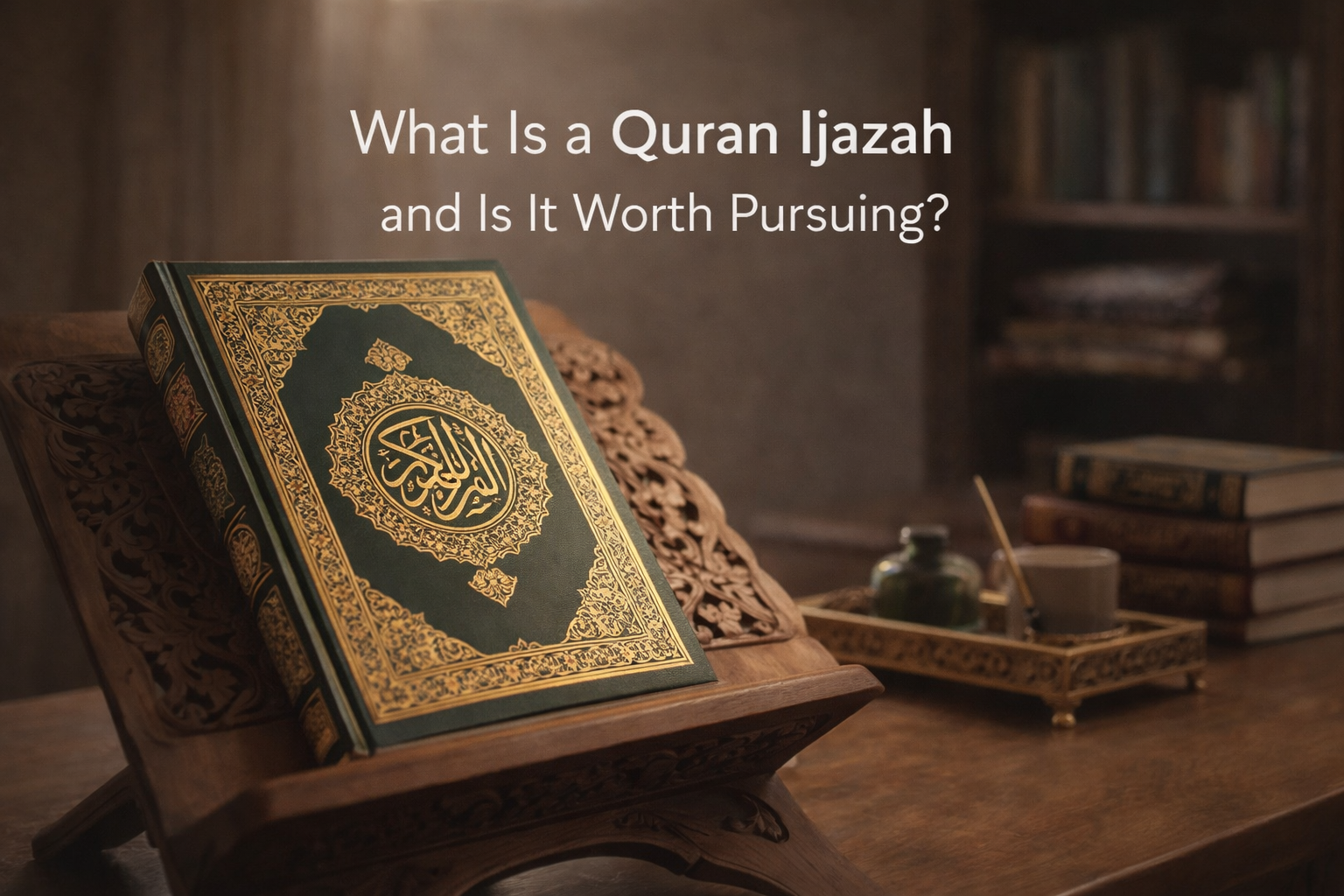

What is a quran ijazah and is it worth pursuing
There is something extraordinary about the way the Quran has been preserved.
Unlike any other book in the world, the Quran has been transmitted from generation to generation not just through paper and ink, but through living human beings – teacher to student, mouth to ear, heart to heart – in an unbroken chain that goes all the way back to the Prophet Muhammad himself.
The formal certification of that chain has a name: the Ijazah.
If you have heard this word and wondered what it means, whether it is only for scholars, or whether it is something you could realistically pursue, this guide will answer every question you have.
What Does Ijazah Mean in Arabic?
The word Ijazah comes from the Arabic root ajaza, meaning to permit or to authorize. In the context of Islamic scholarship, an Ijazah is a formal written certification granted by a qualified teacher to a student, confirming that the student has recited the Quran — or a specific portion of it — to a sufficiently high standard, and granting them permission to teach and transmit what they have learned to others.
The Ijazah is not simply a certificate of completion like a school diploma. It is a link in a living chain. When you receive an Ijazah, your name is added to a list of transmitters that goes back through your teacher, your teacher’s teacher, and every teacher before them, all the way to the companions of the Prophet who learned directly from him, and from him back to the Angel Jibreel, and from Jibreel back to Allah.
That chain is called the Sanad, and it is what makes the Ijazah one of the most unique and sacred credentials in the world.
The History of the Ijazah Chain
The concept of the Ijazah emerged in the earliest generations of Islam as a way to verify and authenticate knowledge. In an era long before printing presses and recorded audio, the only reliable way to confirm that a recitation or a piece of knowledge was authentic was to trace it back through a chain of trustworthy human transmitters.
Islamic scholars developed an extraordinary science — known as Ilm al-Rijal, or the science of narrators — to evaluate the reliability, memory, and character of every person in every chain. This rigorous verification system is what allowed the Quran and the Hadith to be preserved with a level of precision that has no parallel in the history of any other religion or civilization.
The Ijazah tradition continues to this day. There are scholars alive right now whose chains of transmission connect them to the Prophet in as few as twenty or twenty-five generations — a living, verified bridge across fourteen centuries.
Types of Ijazah in the Quran
There are two primary types of Quran Ijazah that students pursue:
Ijazah in Recitation (Riwayat Hafs) is the most common starting point. This certifies that a student has memorized the entire Quran and can recite it flawlessly according to the rules of Tajweed in the Hafs narration, which is the recitation used by the majority of Muslims worldwide. To receive this Ijazah, the student must recite the entire Quran from memory to their teacher without errors.
Ijazah in the Ten Qiraat is a more advanced certification that covers all ten authenticated methods of Quranic recitation. This is a significant undertaking that requires years of dedicated study and a deep mastery of Tajweed and Quranic sciences. It is pursued by serious students of Quranic scholarship.
Both types of Ijazah carry immense spiritual significance and academic weight in the Muslim world.
Who Is the Ijazah For?
This is a question that surprises many people. The Ijazah is not reserved for Islamic scholars, imams, or professional Quran teachers. It is open to any sincere Muslim who has the commitment to pursue it.
Of course, it requires dedication. You need to have memorized the Quran — or at minimum a significant portion of it — and your recitation must meet a rigorous standard of Tajweed. But motivated adult learners, including those who began their Quran journey later in life, have successfully obtained Ijazah through consistent, structured study.
Many people pursue the Ijazah not to become teachers, but for the profound personal and spiritual achievement it represents. Knowing that your recitation has been verified and that your name now sits in a chain connecting you to the Prophet is an experience that is difficult to put into words.
For those who do want to teach the Quran — to their children, in their community, or professionally — the Ijazah is the gold standard of qualification.
How Long Does It Take to Get an Ijazah?
The timeline depends heavily on several factors: whether you have already memorized the Quran, the strength of your existing Tajweed, and the frequency of your sessions with a qualified teacher.
For a student who has already completed Quran memorization and has a solid foundation in Tajweed, the Ijazah in recitation typically takes between six months and two years of dedicated revision and recitation sessions with a certified teacher. For a student who is beginning memorization from scratch, the full journey — from first lessons through to Ijazah — may take between three and seven years depending on pace and consistency.
The most important factor is not speed. It is accuracy. Every single word of the Quran must be recited correctly before the Ijazah can be granted. There are no shortcuts, and there should not be.
How to Enrol in an Online Ijazah Programme
The Ijazah can absolutely be pursued online through live one-on-one sessions — and for many students around the world who do not have access to a certified Ijazah teacher locally, online learning is the only realistic path.
At Al-Badry Academy, our Quran Ijazah Course is taught by certified scholars who hold Ijazah in Quranic recitation with verified chains of narration. Sessions are conducted live, one-on-one, giving every student the personalised attention that this level of study requires.
For students who want to pursue the advanced path of the Ten Qiraat, our 10 Quran Qirat Course provides structured, expert-led instruction with teachers who are themselves certified in multiple Qiraat.
If you are working toward Ijazah and need to strengthen your memorization first, the Quran Memorization Program provides the structured Hifz framework to get you there. You can meet Al-Badry Academy’s certified Quranic scholars on our Our Tutors page and review the full range of Quran courses on our All Quran Classes page.
The journey to Ijazah is one of the most meaningful and rewarding commitments a Muslim can make. It is a gift to yourself, to your family, and to the generations that will learn from you.
Book your free trial class today and take the first step toward joining the unbroken chain that has preserved the words of Allah for over fourteen centuries.