
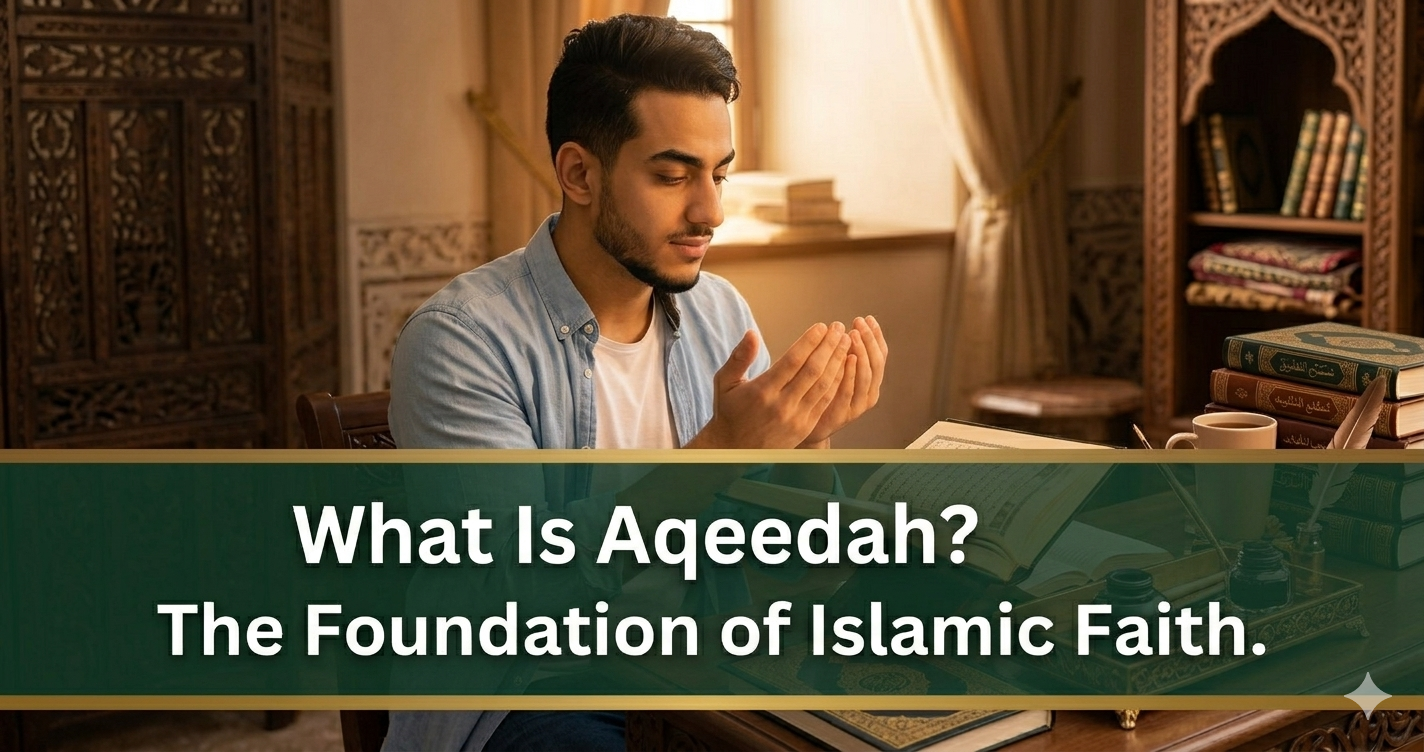

You can pray five times a day, fast in Ramadan, and recite the Quran beautifully. But if the foundation of your belief is shaky, everything built on top of it is at risk.
That foundation is called Aqeedah.
It is the first thing a new Muslim learns. It is the subject that Islamic scholars have written volumes about for over a thousand years. And it is the area that, perhaps more than any other, determines how firmly you stand in your faith when life gets difficult.
This guide explains what Aqeedah means, what it covers, why scholars have always placed it at the very beginning of Islamic education, and how you can start building or strengthening yours today.
The Meaning of Aqeedah
The word Aqeedah (عَقِيدَة) comes from the Arabic root aqada (عَقَدَ), which means to tie, to bind, or to fasten firmly. In Islamic terminology, Aqeedah refers to the core beliefs that a Muslim holds with firm conviction — the beliefs that are tied to the heart and cannot be undone by doubt, confusion, or outside pressure.
It is sometimes translated as “creed” or “doctrine,” but these English words do not fully capture the depth of the Arabic. Aqeedah is not just a list of things you agree with intellectually. It is a set of convictions that shape how you understand the world, how you respond to hardship, and how you relate to Allah (SWT) every single day.
Why Aqeedah Comes Before Everything Else
When the Prophet Muhammad ﷺ was first sent to Makkah, he did not begin by teaching people how to pray or fast. For the first thirteen years of his prophethood, the focus was almost entirely on belief — on who Allah is, on the reality of the Hereafter, on the nature of prophethood, and on purifying the heart from shirk.
The five pillars of Islam came later. The detailed laws of Fiqh came later. Aqeedah came first.
This is not a coincidence. Islamic scholars across centuries have consistently placed Aqeedah at the start of their curricula because they understood a simple truth: your actions are only as strong as the belief behind them. A person who prays without understanding who they are praying to, or who gives charity without believing in accountability before Allah, is building on sand.
Aqeedah is the soil. Everything else grows from it.
The Six Pillars of Iman
The core of Aqeedah is built on the six pillars of Iman (faith), which are mentioned in the famous Hadith of Jibreel (AS) when he asked the Prophet ﷺ about faith:
Belief in Allah is the first and most fundamental pillar. This means believing in His existence, His oneness (Tawheed), His names and attributes, and that He alone deserves worship. This is the pillar that everything else rests on.
Belief in the Angels means affirming the existence of beings created from light who carry out the commands of Allah, including Jibreel (AS) who brought revelation, Mikail (AS), Israfil (AS), and the angel of death.
Belief in the Divine Books means believing that Allah revealed scriptures to His prophets, including the Tawrah (Torah) to Musa (AS), the Injeel (Gospel) to Isa (AS), the Zabur (Psalms) to Dawud (AS), and the Quran to Muhammad ﷺ — and that the Quran is the final, preserved, and uncorrupted revelation.
Belief in the Prophets and Messengers means believing that Allah sent prophets to every nation throughout history to guide humanity, beginning with Adam (AS) and ending with Muhammad ﷺ, the seal of all prophets.
Belief in the Day of Judgement means affirming that this life will end, that every soul will be resurrected and held accountable, and that people will enter either Jannah (Paradise) or Jahannam (Hellfire) based on their deeds and Allah’s mercy and justice.
Belief in Divine Decree (Qadar) means believing that Allah has knowledge of all things before they happen, that He has written everything in Al-Lawh Al-Mahfuz (the Preserved Tablet), and that nothing occurs except by His will — while also affirming that human beings have real choices and are responsible for their actions.
These six pillars are not abstract theology. They are the lens through which a Muslim sees everything — suffering, success, death, and hope.
Common Misconceptions About Islamic Belief
One of the most important roles of Aqeedah study is to protect a Muslim from incorrect beliefs that can slowly weaken or corrupt their faith. Some of the most common misconceptions include:
Many people confuse Tawheed (pure monotheism) with simply saying “I believe in God.” But Tawheed in Islam has specific and detailed implications about the nature of Allah, His attributes, and the exclusive right of worship that belongs to Him alone.
Others struggle with Qadar, wondering how belief in divine decree is compatible with human free will and moral responsibility. Proper Aqeedah study addresses this directly and resolves the apparent contradiction in a way that is deeply satisfying to both the heart and the mind.
Some Muslims hold beliefs about saints, shrines, or intercession that scholars of Aqeedah have carefully examined and addressed. Understanding the correct position protects a person from falling into practices that contradict Tawheed.
Without structured Aqeedah learning, a Muslim is vulnerable to confusion, doubt, and misguidance. With it, they have a clear, firm, and consistent framework for understanding their faith.
How to Build a Stronger Aqeedah
Aqeedah is not just something you study once and move on from. It is something you return to throughout your life, deepening your understanding each time.
Here are practical steps to strengthen yours:
Study the foundations properly, ideally with a qualified teacher rather than just reading books alone. The classical texts of Aqeedah are rich but require explanation and context to be understood correctly. Reflect on the names and attributes of Allah regularly. One of the most powerful ways to strengthen Aqeedah is to spend time understanding who Allah is through His 99 names and what each one means for your relationship with Him. Connect Aqeedah to your daily life by asking yourself how your beliefs in Allah, the Hereafter, and Qadar should change how you respond to what is happening around you right now.
At Al-Badry Academy, our Islamic Classes For Adults cover Aqeedah as part of a structured Islamic Studies curriculum taught by qualified instructors. If you are a new Muslim or just beginning your Islamic education, the New Muslim Converts Course is an excellent starting point that introduces Aqeedah alongside the other fundamentals of the faith.
Learning Aqeedah Online: Where to Start
The good news is that Aqeedah can be learned effectively online, especially through live one-on-one classes where a teacher can answer your questions, address your doubts, and guide you through the material in a way that is personal and relevant to your situation.
Al-Badry Academy offers Islamic Classes for students at every level, from those who are brand new to Islam to those who have been practising for years and want to go deeper. Our instructors are qualified in Islamic scholarship and experienced in making these topics accessible, clear, and spiritually meaningful.
If you have ever felt that your faith could be stronger, that you want to understand what you believe and why, or that you want to give your children a solid Islamic foundation from the start, Aqeedah is where that journey begins.
Book your free trial class today and take the first step toward a faith that is rooted, confident, and unshakeable.
Explore more: Islamic Classes For Kids Hadith Course View Pricing Plans