

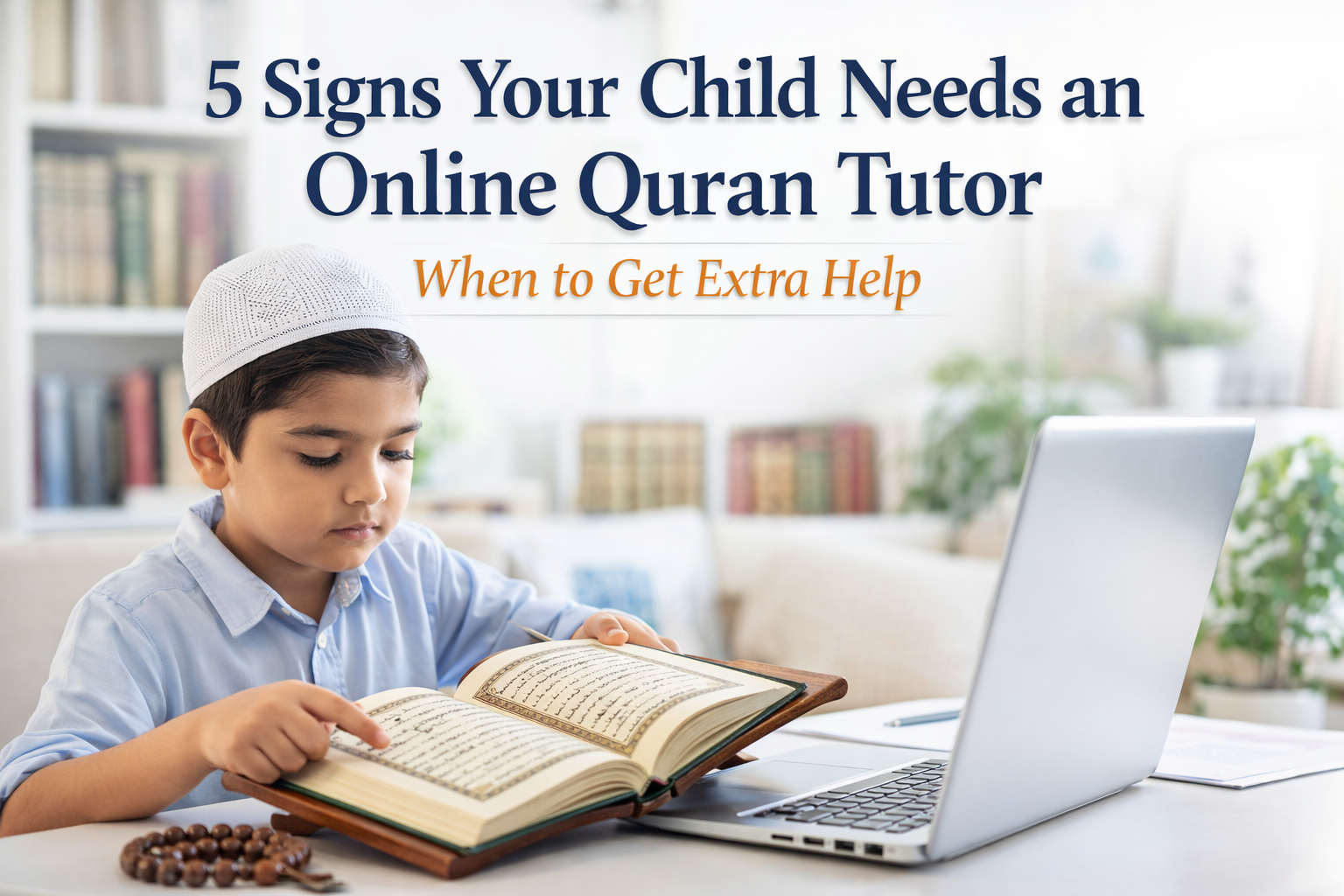

You want your child to develop a strong relationship with the Quran. You encourage practice, sit with them during reading time, and remind them about the importance of learning. But lately, you’ve noticed something isn’t quite right.
Maybe your child resists Quran time more than usual. Perhaps progress has stalled after months of effort. Or you’re seeing mistakes that keep repeating despite correction. These concerns keep nagging at you, and you’re wondering: does my child need professional help?
Recognizing when your child needs an online Quran tutor can transform frustration into progress. This guide will help you identify the clear signs that indicate it’s time to seek expert guidance, and why online tutoring often provides the solution busy families need.
Sign 1: Your Child Struggles with Basic Arabic Letter Recognition
If your child has been learning for several months but still confuses basic Arabic letters, this signals a foundational issue that needs addressing.
Some letter confusion is normal early on. Arabic letters look similar, especially for children used to English. But if your 7-year-old can’t consistently identify letters after 3-4 months of exposure, or if your 10-year-old still mixes up basic shapes, something needs to change.
Common struggles include confusing letters like Ba, Ta, and Tha, or mixing up Seen and Sheen. Children might recognize letters in isolation but struggle when they appear in words. They may guess rather than actually reading.
This often happens when children learn through passive exposure without proper instruction. Sitting in large group classes where the teacher can’t focus on individual struggles leaves gaps. Parents teaching at home, despite best intentions, may lack the technical knowledge to correct pronunciation errors they can’t hear themselves.
A qualified online Quran tutor addresses this directly. Through one-on-one attention, tutors identify exactly which letters cause confusion and why. They use proven methods like Noorani Qaida that systematically build letter recognition through structured repetition. Your child gets immediate correction and personalized practice targeting their specific weak points.
The improvement often surprises parents. With focused attention just 2-3 times weekly, most children master letter recognition within 4-6 weeks. The key is consistent, expert guidance that addresses the root cause rather than hoping the problem resolves itself.
Sign 2: Reading Progress Has Completely Stalled
Your child made good progress initially. Those first few months showed steady improvement. But now, weeks or even months pass with no visible advancement. They’re stuck reading the same level, making the same mistakes, showing no growth.
Stalled progress frustrates everyone. Your child feels discouraged. You feel helpless. The enthusiasm that once characterized Quran time has evaporated, replaced by reluctance and tension.
This plateau often indicates your child has hit a skill level that requires expert instruction to break through. Self-study and parent guidance work wonderfully for basics, but certain stages demand technical knowledge most parents don’t possess.
Maybe your child can read simple words but struggles with complex vowel combinations. Perhaps they’ve memorized short Surahs but can’t apply those skills to new text. They might read mechanically without understanding Tajweed rules that would improve their recitation quality.
These barriers won’t disappear through more practice alone. Repeating the same approach that led to the plateau won’t create breakthrough. Your child needs someone who can diagnose exactly where they’re stuck and provide the specific instruction to move forward.
An experienced online Quran tutor sees these plateaus regularly and knows how to address them. They assess your child’s current level, identify the missing skills, and create a targeted plan. Within weeks, parents typically report renewed progress and restored enthusiasm. The Quran Reading Course approach breaks down complex skills into manageable steps that build confidence while advancing ability.
Sign 3: Pronunciation Errors Keep Repeating Despite Correction
You’ve corrected the same mispronunciation dozens of times. Your child nods, repeats it correctly once, then makes the identical mistake the next day. Certain sounds never quite sound right no matter how many times you explain.
Arabic pronunciation requires precise tongue and throat positions that English doesn’t use. Letters like ‘Ayn, Ghayn, Qaf, and the various forms of H and T have no English equivalent. Without proper technique, children default to the closest English sound, creating habits that become harder to break over time.
The problem compounds when children can’t hear the difference between their pronunciation and correct pronunciation. To their ears, they’re saying it right. Your corrections seem arbitrary or nitpicky. They don’t understand what needs changing because they genuinely can’t perceive the error.
This situation requires someone trained in Arabic phonetics who can demonstrate proper technique. Online Quran tutors certified in Tajweed know exactly how to position the mouth, where to place the tongue, and how to produce each sound correctly. More importantly, they can see your child’s mouth position through video and provide immediate, specific corrections.
Through Tajweed Rules Course instruction, children learn the science behind beautiful recitation. They understand why certain letters sound specific ways and how to produce those sounds consistently. With regular practice under expert supervision, proper pronunciation becomes natural rather than forced.
The transformation usually happens faster than parents expect. Once children learn the correct technique for problematic sounds, muscle memory develops quickly. Most pronunciation issues resolve within 2-3 months of focused instruction from a qualified tutor.
Sign 4: Your Child Avoids or Resists Quran Learning Time
Quran time used to be manageable, maybe even enjoyable. Now it’s a battle. Your child finds excuses, delays, complains, or openly resists. What should be a blessed activity has become a source of household tension.
This resistance often signals deeper issues than simple laziness or disinterest. Children naturally avoid activities where they feel unsuccessful or frustrated. If Quran learning consistently feels hard, confusing, or embarrassing, resistance is a protective response.
Consider what your child experiences during Quran time. Do they struggle while siblings succeed? Do they make mistakes that draw attention in group settings? Does practice feel endlessly repetitive without visible improvement? These experiences breed discouragement that manifests as avoidance.
Forcing a resistant child rarely works long-term. Pressure might get temporary compliance but damages their relationship with the Quran. The goal isn’t just reading ability but lifelong love and connection with Allah’s words. That requires positive associations, not negative ones.
A skilled online Quran tutor changes this dynamic completely. One-on-one lessons eliminate the embarrassment of public mistakes. Your child can ask questions freely, make errors safely, and progress at their own pace. Tutors trained in teaching children know how to make lessons engaging, celebrate small wins, and build genuine confidence.
Parents consistently report that resistance melts away once children experience success and feel understood. The Quran classes designed specifically for different age groups ensure your child receives age-appropriate instruction that matches their developmental stage and learning style.
When children feel capable and supported rather than frustrated and judged, their natural curiosity and desire to please Allah emerges. Quran time transforms from a dreaded obligation into an activity they approach with confidence and even enjoyment.
Sign 5: You Don’t Have the Knowledge or Time to Teach Properly
This might be the most common sign, and there’s no shame in acknowledging it. You want to support your child’s Quran education, but you recognize your own limitations.
Maybe you can read Quran yourself but lack the technical knowledge to teach proper Tajweed rules. Perhaps your Arabic pronunciation has errors you don’t realize. Or you simply don’t have the time that quality instruction requires given work, household responsibilities, and other children’s needs.
Many parents feel guilty about this reality. You think you should be able to teach your own child. But teaching Quran effectively requires specific skills, knowledge, and time that not every parent possesses, and that’s completely okay.
Professional teachers spend years learning not just Quran recitation but how to teach it. They understand child development, learning psychology, and effective pedagogical techniques. They know how to break complex skills into simple steps, identify learning obstacles, and adjust their approach based on individual needs.
Your role as a parent remains crucial. You provide encouragement, ensure practice happens, and model the importance of Quran learning. But the technical instruction can and often should come from trained professionals, especially if you notice your child isn’t progressing or you feel uncertain about what to teach next.
Online Quran tutors offer the expertise you need without requiring you to become an expert yourself. They bring qualified instruction directly to your home on a schedule that works for your family. You can observe lessons, support practice between sessions, and maintain your vital role as encourager and motivator while leaving the technical teaching to professionals.
This combination of professional instruction and parental support creates ideal learning conditions. Children receive expert guidance while knowing their parents value and prioritize their Quran education. Book a free trial class to see how professional instruction complements your role as a supportive parent.
Why Online Quran Tutoring Works So Well for Children
Online learning might seem less effective than in-person instruction, but for Quran education, it often works better, especially for children.
One-on-one attention makes the biggest difference. In traditional group settings, teachers divide attention among 10, 15, or 20 students. Your child might get a few minutes of individual focus during an hour-long class. Online tutoring provides 30-45 minutes of completely personalized instruction every session. The tutor focuses entirely on your child’s needs, pace, and challenges.
Learning from home eliminates stress and distractions. Your child learns in a comfortable, familiar environment without the social pressures or distractions of group settings. Shy children speak up more freely. Active children focus better without peers nearby. The home setting naturally reduces anxiety and increases engagement.
Flexible scheduling accommodates busy family lives. You choose class times that work around school, sports, and other commitments. If someone gets sick or schedules change, rescheduling is typically simpler than with in-person classes. This flexibility means consistent learning without the stress of rigid schedules.
Access to highly qualified teachers expands dramatically. You’re not limited to whoever teaches at your local mosque or Islamic center. Online platforms connect you with certified teachers holding proper Ijazah, sometimes from scholars your local area couldn’t access. You can choose teachers whose style matches your child’s personality and learning needs.
Parents can easily monitor progress. You can sit in on lessons, hear exactly what the teacher covers, and understand what your child should practice. This visibility helps you support learning between sessions and stay involved in your child’s Quran education in meaningful ways.
The technology itself engages tech-native children. Most kids today are comfortable with video calls and digital interaction. The online format feels natural to them, often more so than traditional classroom settings. Teachers can use digital tools, visual aids, and interactive techniques that enhance engagement and learning.
What to Look for in an Online Quran Tutor
Not all online Quran tutors offer the same quality. Knowing what to look for protects your investment and your child’s learning.
Proper certification matters most. Your tutor should have Ijazah certification, meaning they’ve been authorized to teach Quran by qualified scholars. This certification ensures they learned from a proper chain of teachers tracing back to the Prophet Muhammad (peace be upon him). It guarantees they know correct recitation, pronunciation, and Tajweed rules.
Experience teaching children specifically makes a huge difference. Teaching adults and teaching children require different skills. Ask about the tutor’s experience with your child’s age group. How long have they taught children? What methods do they use to keep young learners engaged? Can they provide references from other parents?
Teaching methodology should be structured and proven. The best tutors use systematic approaches like Noorani Qaida rather than random or improvised methods. They should explain their teaching progression and how they assess student progress.
Communication skills matter beyond just Arabic knowledge. Your tutor needs to explain concepts clearly, provide encouragement, and build positive relationships with students. They should communicate regularly with you about your child’s progress, strengths, and areas needing work.
Patience and flexibility are essential for working with children. Different children learn at different speeds and have different needs. Your tutor should adapt their pace and approach based on your child’s response rather than forcing every student through an identical program.
Trial classes let you evaluate these qualities before committing. Reputable academies like Al-Badry Academy offer free trial classes so you can assess teaching quality, see how your child responds to the tutor, and make informed decisions.
How to Prepare Your Child for Online Quran Lessons
Starting with an online tutor works best when you prepare your child properly. A little preparation prevents resistance and sets up success.
Explain why they’re getting a tutor in positive terms. Avoid framing it as punishment for poor performance or because they’re “bad” at Quran. Instead, emphasize that everyone learns better with expert help, just like having a coach for sports. The tutor is there to help them succeed and make Quran learning easier and more enjoyable.
Set up a dedicated learning space free from distractions. Your child needs a quiet area with good lighting where they can focus during lessons. Having the same spot for every class creates routine and signals that lesson time is special and important.
Ensure technology works properly before the first lesson. Test the internet connection, camera, and microphone. Make sure your child knows how to join the video call or that you’ll be there to help. Technical problems during lessons waste valuable learning time and frustrate everyone.
Establish clear expectations about behavior and effort. Your child should understand that lesson time means paying attention, trying their best, and treating the teacher with respect. Set consequences for not meeting these expectations and rewards for good effort and progress.
Stay nearby during initial lessons, especially for younger children. Your presence provides security and allows you to help with technical issues or translate if needed. As your child becomes comfortable, you can gradually give them more independence while remaining available if needed.
Commit to supporting practice between lessons. The tutor provides instruction, but your child needs to practice what they learn. Help them set aside daily practice time and show interest in what they’re working on. Your involvement reinforces that Quran learning matters to your family.
Common Questions Parents Ask About Online Quran Tutors
Making the decision to hire a tutor brings up many questions. Here are answers to what parents most often ask.
How much do online Quran tutors cost? Prices typically range from $40-80 monthly for 2-3 weekly classes. Factors affecting cost include teacher qualifications, class length, and package size. More experienced tutors with advanced certifications charge higher rates but often deliver faster results. Check pricing options to find packages that fit your budget.
How long until we see improvement? Most parents notice positive changes within 2-4 weeks. This might mean better pronunciation, increased confidence, or renewed enthusiasm. Significant skill improvement typically takes 2-3 months of consistent lessons and practice. Remember that building strong foundations takes time but pays off long-term.
How many classes per week does my child need? Most children benefit from 2-3 classes weekly, each lasting 30-45 minutes. This provides enough instruction to make steady progress while allowing time for practice between lessons. More frequent classes work for highly motivated students or those preparing for specific goals like Quran memorization.
What if my child doesn’t connect with the tutor? Personality fit matters for effective learning. Reputable academies allow tutor changes if the initial match doesn’t work well. Don’t hesitate to request a different teacher if your child seems uncomfortable or disengaged after a few lessons.
Can siblings share lessons? This depends on their ages and skill levels. Siblings at similar levels might benefit from shared lessons at reduced cost. However, children at different stages usually learn better individually so each gets instruction matched to their needs. Discuss options with the academy to find the best arrangement.
What happens during summer or family vacations? Good online academies offer flexible scheduling. You can pause lessons during extended travel, reduce frequency during busy periods, or reschedule around vacations. This flexibility is a major advantage over rigid in-person schedules.
Taking the Next Step: Getting Started with an Online Quran Tutor
You’ve recognized the signs. You understand why online tutoring works. Now it’s time to take action and get your child the help they need.
The decision to seek expert help shows wisdom and commitment to your child’s Islamic education. You’re not giving up on teaching them yourself; you’re ensuring they receive the quality instruction they deserve. This investment in their Quran learning impacts their entire life and relationship with Allah.
Start by having an honest conversation with your child about getting a tutor. Explain that you want to help them succeed, that everyone learns better with expert teachers, and that you believe in their ability to improve with the right support. Frame it as an opportunity, not a punishment.
Research and compare academies to find the right fit. Look for proper teacher credentials, positive parent reviews, clear pricing, and flexible policies. Al-Badry Academy offers all these features plus proven teaching methods and highly qualified instructors specifically trained for different age groups and skill levels.
Schedule a trial class before committing. This lets your child meet the teacher, experience the teaching style, and see how online lessons work. You can assess whether the tutor connects well with your child and uses effective methods. Most issues that concern parents disappear after they observe a quality trial lesson.
Prepare to support the process with consistency and encouragement. Hiring a tutor isn’t a magic solution that requires nothing from you. Your child still needs regular practice, your involvement, and your encouragement. The combination of expert instruction and parental support creates the ideal environment for Quran learning success.
Don’t delay based on guilt, cost concerns, or uncertainty. Every week that passes is another week your child struggles, loses confidence, or develops bad habits that become harder to correct. The sooner you act, the sooner you’ll see positive changes.
Your child deserves to experience the joy and confidence that comes from successfully learning the Quran. With the right tutor providing expert guidance, that success is absolutely achievable. Take the first step today by booking a free trial class and seeing the difference professional instruction makes.
Final Thoughts: Investing in Your Child’s Relationship with the Quran
Teaching children the Quran is one of the most important responsibilities Muslim parents carry. It’s also one of the most challenging, especially when progress stalls, problems persist, or your own knowledge feels inadequate.
Recognizing when your child needs expert help isn’t an admission of failure. It’s an act of wisdom and love. You’re prioritizing their success and their relationship with Allah’s words over pride or assumptions about what you should be able to do yourself.
Online Quran tutors provide the expertise, individual attention, and structured approach that transforms struggling students into confident readers. The investment of time and money pays dividends not just in improved reading skills but in your child’s lifelong connection to the Quran.
If you’ve recognized any of the five signs discussed in this guide, don’t wait. The longer problems persist, the more ingrained they become and the harder they are to correct. Taking action now sets your child on a path to Quran learning success that will benefit them for years to come.
Your child’s Quran education matters. Give them the gift of expert instruction from qualified teachers who can unlock their potential and help them develop the skills and love for the Quran they deserve. Start with a free trial class and see the difference professional guidance makes in your child’s learning journey.
Frequently Asked Questions
At what age should I consider getting my child an online Quran tutor?
Children as young as 5-6 can benefit from online Quran tutors if they show interest and can sit through 20-30 minute lessons. However, ages 7-12 are typically ideal because children have developed enough focus and maturity to maximize learning while still being in prime language acquisition years. Older children and teens also benefit greatly, especially if they’re experiencing the struggles mentioned in this article.
How do I know if the tutor is qualified and trustworthy?
Look for tutors with Ijazah certification in Quran recitation, which proves they learned from authorized teachers in a proper chain. Ask about their educational background, years of teaching experience, and whether they have experience with your child’s age group. Reputable academies like Al-Badry Academy provide transparent information about their teaching team and credentials. Always start with trial classes to assess quality yourself.
Will online lessons work for my child who has trouble focusing?
Online lessons often work better for children with focus challenges because of the one-on-one format. Tutors can use engaging techniques, take short breaks when needed, and adapt their approach to your child’s attention span. Lessons are typically shorter (30-45 minutes) than group classes, and the home environment reduces distractions compared to busy classroom settings. Many parents report improved focus precisely because of the personalized nature of online instruction.
What if my child falls behind in lessons or needs to miss classes?
Good online academies offer flexible make-up policies for missed classes. Most allow you to reschedule lessons with advance notice. If your child falls behind, the tutor simply slows the pace and provides extra review until they’ve mastered the material. This is actually an advantage of one-on-one tutoring; the curriculum adjusts to your child rather than your child being forced to keep up with a group’s pace.
Can my child learn Quran memorization from an online tutor?
Absolutely. Many students successfully complete Quran memorization programs online. Tutors use proven memorization techniques, provide daily review, and track progress carefully. The one-on-one format actually enhances memorization because the tutor can correct mistakes immediately and ensure perfect memorization before moving to new portions. Many students find online memorization more effective than group settings where individual attention is limited.