
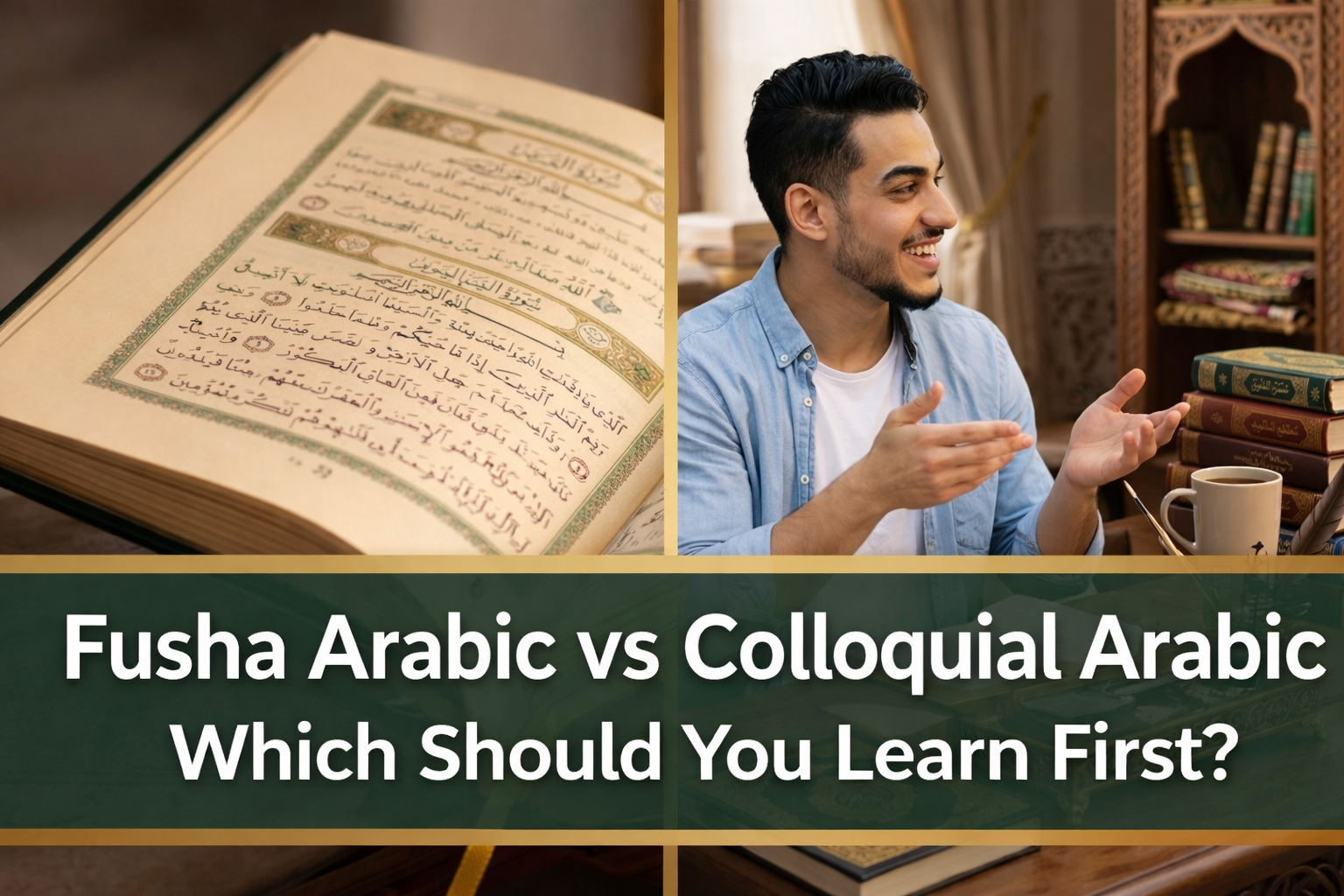

Fusha arabic vs colloquial arabic which one should you learn first
Category: Arabic Focus Keyword: Fusha Arabic Meta Description: Fusha Arabic or colloquial Arabic — which should you learn first? Understand the key differences and find out which path is right for your goals.
You have decided to learn Arabic. You open your browser, search for a course, and immediately hit a wall. Some courses teach “Modern Standard Arabic.” Others teach “Egyptian Arabic” or “Levantine Arabic.” Some say start with Fusha, others say go straight to conversational. Which one is right?
This question confuses more learners than almost anything else in the Arabic learning journey. The answer depends entirely on why you want to learn Arabic in the first place, and this guide will help you figure that out.
What Is Fusha Arabic?
Fusha (فُصْحَى) is the formal, classical form of Arabic. It is the language of the Quran, Islamic scholarship, Arab literature, formal news broadcasts, official documents, and academic writing across the Arab world.
There are two closely related forms of Fusha:
Classical Arabic is the language of the Quran and early Islamic texts. It is the purest and most preserved form of the language and has remained largely unchanged for over 1,400 years.
Modern Standard Arabic (MSA) is a standardised version of Classical Arabic used in contemporary formal contexts like newspapers, books, speeches, and pan-Arab media such as Al Jazeera. It shares the same grammar and most of the same vocabulary as Classical Arabic, with some modern additions.
When Muslims around the world read the Quran, study Islamic texts, or perform Salah, they are using Fusha. This is why Fusha is often called the “universal” form of Arabic — it is understood by educated Arabic speakers from Morocco to Malaysia.
What Is Colloquial (Aamiyya) Arabic?
Colloquial Arabic, known as Aamiyya (عامية), refers to the spoken dialects used in everyday life across different Arab countries. Each country or region has its own dialect:
Egyptian Arabic is the most widely understood due to the influence of Egyptian cinema and television. Levantine Arabic is spoken in Syria, Lebanon, Jordan, and Palestine. Gulf Arabic is used in Saudi Arabia, the UAE, Kuwait, and surrounding countries. Moroccan Darija is significantly different from other dialects and can be difficult even for other Arab speakers to understand.
These dialects are not written formally, they are not used in religious contexts, and they vary significantly from country to country. A conversation in Moroccan Arabic and a conversation in Gulf Arabic can feel like two entirely different languages.
The Key Differences Between Fusha and Aamiyya
The most important distinction is the context in which each is used. Fusha is the written, formal, and religious language. Aamiyya is the spoken, everyday, regional language.
In terms of grammar, Fusha follows a strict, consistent grammatical structure that applies across the entire Arabic-speaking world. Aamiyya has simplified grammar that varies by region and is rarely written down in a standardised way.
In terms of vocabulary, Fusha draws from Classical Arabic roots with logical word formation rules. Aamiyya often borrows from French, Turkish, Italian, or English depending on the region’s history.
In terms of religious use, Fusha is essential. The Quran, Hadith, Islamic jurisprudence, and all five daily prayers are in Fusha. Aamiyya has no role in Islamic worship or study.
Which One Helps You Understand the Quran Better?
If your goal is to understand the Quran, connect with Islamic texts, or deepen your worship, Fusha is the clear and only choice.
The Quran was revealed in clear, classical Fusha Arabic. Every word, every construction, every grammatical nuance in the Quran is part of the Fusha tradition. Learning a dialect will not help you understand a single verse of the Quran more deeply.
When you study Fusha, specifically Quranic Arabic, you begin to notice things you never noticed before. You understand why a verse is phrased a certain way. You recognise root words that appear across dozens of Surahs. You feel the weight of words that translation simply cannot capture.
Al-Badry Academy’s Quranic Arabic Course is specifically designed to help you understand the language of the Quran directly, without needing a translation as a crutch. It is one of the most meaningful investments a Muslim learner can make.
Which One Is Better for Travel and Daily Communication?
If your goal is to travel to an Arab country, make friends, watch Arabic TV shows, or communicate casually with Arabic speakers in daily life, then a dialect is more practical for that specific purpose.
However, there is an important caveat. If you learn Fusha first and build a strong foundation, picking up a dialect later is significantly easier. The grammar, the vocabulary roots, and the reading ability you develop in Fusha give you a massive head start when you later choose to add a dialect.
The reverse is not as efficient. Learning a dialect first gives you conversational ability in one specific region, but it does not prepare you for formal contexts, does not help you read Arabic, and does not connect you to Islamic knowledge at all.
The Best Path: Learn Fusha First, Then Add a Dialect if Needed
For the vast majority of Muslim learners, the most strategic and rewarding path is to start with Fusha Arabic, specifically Quranic Arabic and grammar, and then add a spoken dialect later if your lifestyle or goals require it.
Here is why this works:
Fusha applies everywhere — to prayer, to Quran, to Islamic study, to formal communication across all Arab countries. It is the investment that keeps paying back across every area of your life as a Muslim.
If you are unsure where to start, Al-Badry Academy offers several pathways depending on your level and goals. The Arabic Grammar Rules Course builds the structural foundation you need to read and understand Arabic properly. The Arabic Fusha Course takes you into formal Modern Standard Arabic for reading, writing, and comprehension. And the Arabic Conversation Course is available for those who want to develop their spoken skills once the foundation is in place.
You can explore all available options on the All Arabic Classes page to find the course that fits where you are right now.
Start Your Arabic Journey with the Right Foundation
The question of Fusha vs. colloquial Arabic is really a question of purpose. Know why you want to learn Arabic, and the answer becomes clear.
If you want to understand the Quran, deepen your worship, study Islam, or communicate across the entire Arab world, Fusha is your path. It is the language that connects you to 1,400 years of Islamic knowledge and to the direct words of Allah (SWT).
Al-Badry Academy’s certified native Arabic tutors teach live, one-on-one classes tailored to your pace, your goals, and your schedule. Whether you are an absolute beginner or already have some reading ability, there is a course designed for exactly where you are.
Book your free trial class today and start building the Arabic foundation that will serve you for life.
Explore more: Quranic Arabic Course Noorani Qaida Course View Pricing Plan