Ever heard a Moroccan reciter and thought the verse sounded different from the one you grew up with? It’s not a mistake. Hafs and Warsh are both authentic narrations, passed down from the Prophet ﷺ, and that gap is what the Qira’at are about. Mastering seven takes a teacher who listens. So how can you learn 7 Qiraat online?
How Can You Learn the 7 Qira'at Online?
Short answer: find a certified shaykh and study in stages. You recite live, and your teacher fixes every difference as it happens. The 7 Qira’at course covers the seven imams (two Riwayat each), the Usul and Farsh, and Jam’ al-Qira’at, with Ash-Shatibiyyah as the core reference. It cures the usual headaches — readings that blur, rules nobody checks, no Sanad. Here’s the detail.
Key Takeaways
- Seven imams, two Riwayat each, plus Usul and Farsh.
- No memorization or fluent-reading test to pass. Your teacher meets you at your level.
- Every lesson is live and one-on-one. Recordings are for review and practice — they never replace the live class.
- A certificate comes with the course, but the Ijazah with connected Sanad has to be earned in a recitation assessment.
So what is the course, exactly — and who’s it for?
Live One-on-One Classes | Recorded Sessions | Certified Teachers | Certificate of Completion | Ijazah with Sanad
What Is the 7 Qira'at Course?
Albadry Academy’s 7 Qira’at course teaches the Seven Canonical Qira’at from start to finish. Quick vocabulary first. A qira’ah is a reading tied to one imam; a riwayah is the version one of his students narrated. Scholars only accept a reading with a sound chain, a fit with the Uthmani script and agreement with Arabic grammar (the Qira’at article on Wikipedia lays this out). Ibn Mujahid, back in the fourth Islamic century, was the first to cap the canonical readings at seven. A Mutawatir Qira’at course like ours takes them one stage at a time.
Who Is This Course For?
This Qira’at Sab’ah course suits:
- Huffaz who want to widen their recitation, as a Qira’at course for Huffaz
- Tajweed students ready for the next level
- Teachers and imams who plan to teach the Qira’at
- Students chasing an Ijazah with connected Sanad
- Non-Arabic speakers, at any level (Tajweed can be learned and sharpened with us)
- Kids & Teens
Prerequisites
There’s no entry test here. Full memorization isn’t required, and neither is fluent reading — you don’t even need to be a Hafs reciter. Your teacher meets you at your level and builds from there. Want a stronger base alongside? Try our Quran Reading Course or Tajweed Rules Course.
What You Will Learn
Here’s how you master the seven Qira’at of Quran, one layer at a time.
The Seven Canonical Qira’at and Their Imams
| Imam | City | Two Riwayat |
|---|---|---|
Nafi’ |
Madinah |
Qalun, Warsh |
Ibn Kathir |
Makkah |
Al-Bazzi, Qunbul |
Abu Amr |
Basra |
Ad-Duri, As-Susi |
Ibn Amir |
Damascus |
Hisham, Ibn Dhakwan |
Asim |
Kufa |
Shu’bah, Hafs |
Hamzah |
Kufa |
Khalaf, Khallad |
Al-Kisa’i |
Kufa |
Abu al-Harith, Ad-Duri |
The Two Riwayat of Each Qira’ah
Every imam has two main narrators, so that’s fourteen Riwayat. Hafs from Asim is the one you’ve almost certainly heard if you grew up in the East. Warsh from Nafi’ runs through North and West Africa. We’ll show you where they split — vowel lengths, certain letters, even the wording of a few words.
Recitation Rules and Variations Across Qira’at (Usul & Farsh)
Usul are the rules that repeat across lots of words (madd lengths, for instance). Farsh are the differences in particular words and verses. Your teacher drills both live. Looking for a Shatibiyyah course online? We study the poem alongside recitation, because it packs these rules into verse.
Jam’ Al-Qira’at
Jam’ means combining several readings in a single recitation. It comes last, and for good reason. Each reading has to stand firmly on its own first — otherwise they bleed into each other.
Course Roadmap
- Foundation (review your Tajweed, recite fluently)
- The Riwayat (each imam’s narrations, with their Usul)
- Farsh (word-level differences, with Ash-Shatibiyyah as a reference)
- Jam’ al-Qira’at (combining readings accurately)
- Assessment (recitation review, certificate, Ijazah if you qualify)
Revision and assessment happen at every stage, so you’re never left guessing how you’re doing. No rush, either — you move on once the last stage is solid, and your pace sets the timeline.
Teaching Method
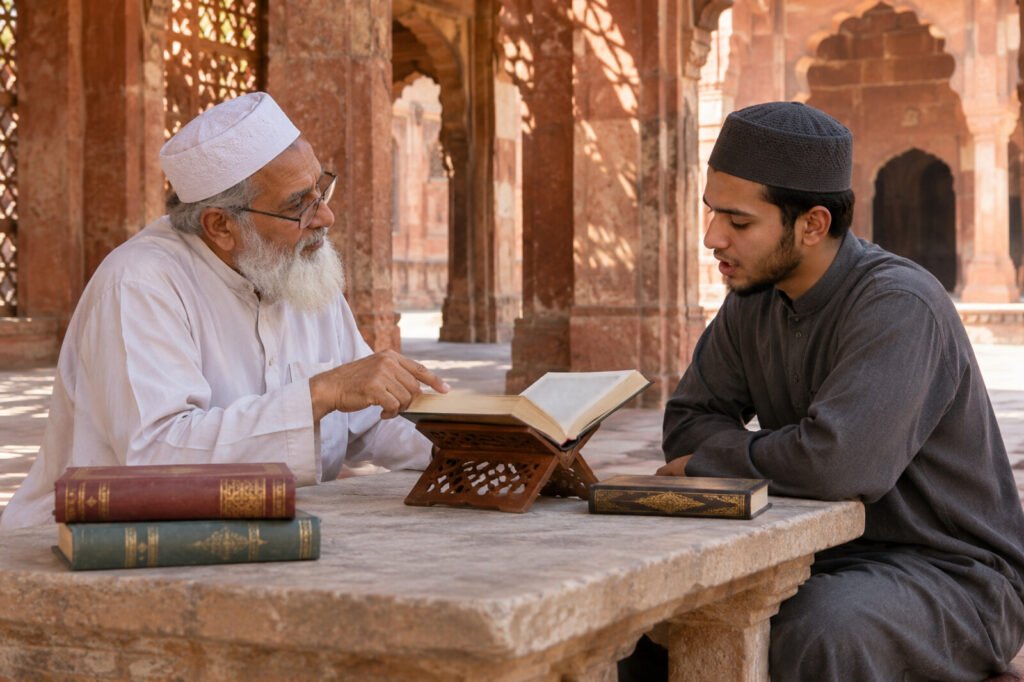
These 7 Qira’at recitation lessons are live and one-on-one. You recite, your teacher corrects you right away, and the session gets recorded so you can review and practise again (the live class always comes first). Plus, lessons can be explained in English, Arabic or other languages. Looking for an online Quran Qira’at teacher who hears every single word? That’s exactly the format.
Instructors & Credentials
Planning to learn Quran Qira’at with Sanad? Check the teacher first. A qualified one holds an Ijazah in the seven Qira’at with a connected Sanad, earned by reciting to a certified shaykh. Our teachers hold exactly that, and they correct you live. Meet them on our tutors page. Sisters can learn with qualified female teachers.
Learning Outcomes, Certificate & Ijazah / Sanad
By the end you should be able to recite each of the seven Qira’at with its Riwayat, apply the Usul and Farsh correctly, and explain how the readings differ. You’ll get a certificate of completion from Albadry Academy. The Ijazah is a separate matter. A Qira’at course with Ijazah ends with a recitation assessment by a certified teacher, and only then is the Ijazah with connected Sanad awarded (it links your recitation back to the Prophet ﷺ).
Want to go wider? See our 10 Quran Qirat Course, Quran Ijazah Course and Online Qari Course.
Why Learn Qira'at with Albadry Academy?
Searching for a Seven Qira’at course online? Compare the best online course for Shatibiyyah Qira’at by asking two things: who holds the Sanad, and who corrects you. With us you get:
- A 7 Qira’at course with live one-on-one teacher format
- Teachers with Ijazat and connected Sanad
- A staged path, one mastered step at a time
It’s also a welcoming way to learn Qira’at online for non-Arabic speakers — and for anyone else, whatever your level — since lessons can be explained in your language and your teacher sets the pace with you. More programs live in our Quran Classes category.

Start Your Qira'at Journey Today
Book a free trial, meet your teacher and see where you stand. No commitment needed. Aiming for an online 7 Qira’at course with Ijazah and Sanad? Our Advanced Seven Qira’at course with certified shaykhs is built for exactly that.
Frequently Asked Questions
It’s Albadry Academy’s online program for the seven canonical Quran recitations, covering their Riwayat, Usul and Farsh. You study in stages and move on only when the last stage is solid — so nothing gets rushed, and nothing gets half-learned.
The seven are mutawatir (mass-transmitted) recitation methods linked to Nafi’, Ibn Kathir, Abu Amr, Ibn Amir, Asim, Hamzah and Al-Kisa’i. Each imam has two narrators, known as Riwayat (Hafs and Shu’bah, say, both narrate from Asim). That makes fourteen in all.
A Qira’ah is a reading attributed to an imam, like Asim. A Riwayah is one student’s version of it, like Hafs. Tajweed? That’s the set of pronunciation rules applied inside each. Layers, basically: the imam’s reading, the narrator’s version, then the sound rules on top.
Ten Qira’at? That’s the seven plus Abu Ja’far, Ya’qub and Khalaf. Most people start with the seven, get them solid, and then move up to the ten. It’s a natural next step, not a detour, and nothing you learn first goes to waste.
Hafs is the Riwayah of Hafs from Asim; Warsh is the Riwayah of Warsh from Nafi’. The differences are small but real — vowel lengths, how certain letters sound. Hafs is by far the most widespread worldwide. Warsh holds its ground across North and West Africa.
Someone with an Ijazah and a connected Sanad in the seven Qira’at, earned by reciting to a certified shaykh. Albadry Academy’s teachers hold exactly that, and they correct your recitation live — so you learn straight from people qualified to teach it.
Not as a strict requirement. Tajweed helps, since every reading builds on correct pronunciation, but you can learn and sharpen it with us as you go. And no, you don’t need to be a Hafs reciter. Want a firmer base first? Try our Online Tajweed Rules Course.
No. Full memorization and fluent reading aren’t mandatory prerequisites, so you can apply whatever your current level. Memorization does help when you compare readings side by side (see our Quran Memorization Program), but your teacher meets you where you are and builds from there.
Yes. You recite live to a qualified teacher, from wherever you are, and get corrected on the spot. Plus, recordings let you review each session between lessons (they never replace the live class). No travel, no commute. Curious? Book Your Free Trial Now first.
Yes. Lessons are available in English, Arabic and other languages, so language won’t hold you back. Your teacher adjusts the pace to your level, which means nobody gets left behind and nothing feels rushed. New to the Qira’at or already familiar with some? You’re welcome either way.
Honestly? It depends. Your level, how quickly things sink in, how much you study each month — all of it counts. And since you only move on once a stage is solid, your pace sets the calendar. There’s no fixed finish line.
Classes are live, one-on-one sessions with a qualified teacher. Recordings exist too — handy for reviewing a lesson between classes, though they never replace the live session. You recite, your teacher listens and corrects, and every lesson stays personal to your level.
Yes, once you reach the required level — but never automatically. First a certified teacher assesses your recitation. Only after that comes the Ijazah with connected Sanad, linking your recitation back to the Prophet ﷺ. That chain? It’s the whole point.
Yes. You get a certificate of completion from Albadry Academy when you finish. It’s separate from the Ijazah (that one is awarded only after you show mastery of the Qira’at in a recitation assessment with a certified teacher). Two different things.
Ash-Shatibiyyah, also known as Hirz al-Amani wa Wajh al-Tahani, is a classical poem by Imam Ash-Shatibi that sums up the rules of the seven Qira’at, Usul and Farsh included. And yes, you’ll study it as a core reference alongside live recitation practice.
Yes, no strings attached. You’ll meet your teacher, have your level checked and sit through a live one-on-one lesson — all before you decide anything. Nobody pressures you afterwards. Ready? Book Your Free Trial Now and see how it feels.
Yes. Female students can learn with qualified female teachers. Tell us your preference when you book and we’ll match you with an instructor who suits your level and your schedule — so you feel comfortable from the very first lesson.
Yes — and it matters. Our teachers hold Ijazat with a connected Sanad in the seven Qira’at, earned by reciting to a certified shaykh. They correct you live, and they track how you’re doing. Want details on a particular teacher? Just ask during your free trial.
Yes. Kids and teens get their own classes, apart from the adults, with a pace and style that fits their age and level. See our Online Quran Classes for Kids. Just say who’s joining when you book, and we’ll pick the right instructor.