

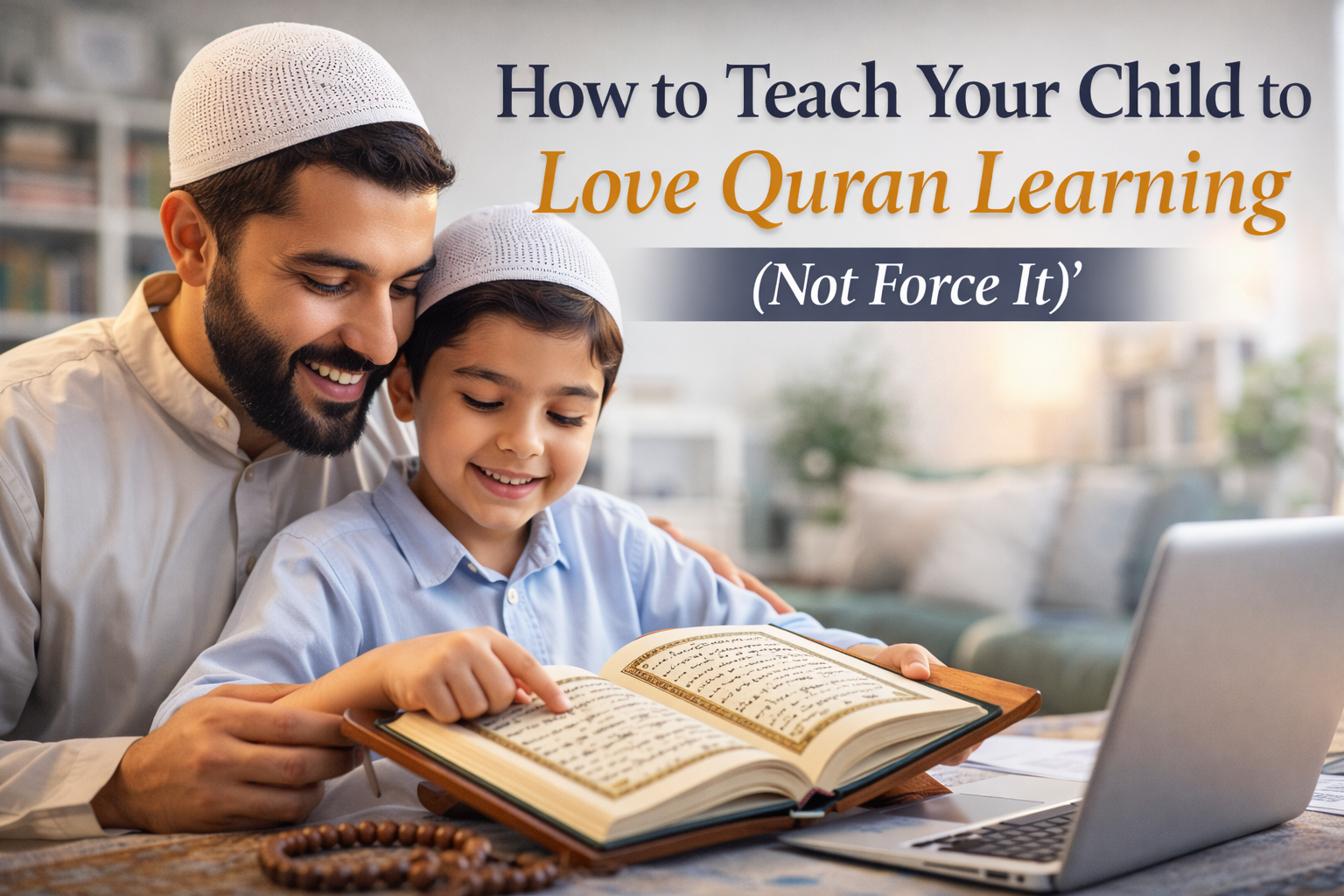

Your child drags their feet when it’s time for Quran practice. They complain, make excuses, or sit through lessons with obvious reluctance. You remind yourself that learning the Quran is important, that this resistance is temporary, that you just need to push through. But deep down, you wonder if forcing the issue is creating the opposite of what you want: a lifelong disconnection from Allah’s book.
You’re facing one of the most common challenges Muslim parents encounter. You want your child to develop genuine love for the Quran, not just mechanical ability to read it. You want them to turn to Allah’s words for comfort and guidance throughout their lives, not to associate the Quran with negative childhood memories of being forced to study.
The good news is that children can absolutely learn to love Quran study when parents approach it correctly. This comprehensive guide shows you exactly how to transform Quran learning from a dreaded obligation into an activity your child approaches with genuine enthusiasm and spiritual connection.
Understanding Why Children Resist Quran Learning
Before exploring solutions, understanding why children resist helps you address root causes rather than just symptoms.
They Don’t Understand the Purpose
Most children resist activities that feel pointless to them. When adults tell them “you have to learn Quran” without explaining why it matters, children see it as arbitrary adult demands rather than meaningful pursuit.
Young children especially struggle with abstract concepts like spiritual reward or preparing for the hereafter. These ideas don’t connect to their immediate reality of school, friends, and play. Without understanding why Quran matters, it feels like pointless work imposed by adults.
The solution starts with age-appropriate explanation of purpose. For young children, this might be simple: “The Quran is Allah’s special message to us. Learning it helps us know what Allah wants us to know.” For older children, you can explore deeper concepts about guidance, connection with Allah, and preparation for life.
Make the purpose concrete. Instead of vague “it’s important,” explain specific benefits they can understand: “When you know Quran, you can recite beautiful verses in your prayers. You’ll understand what the imam is saying on Fridays. You’ll be able to comfort yourself with Allah’s words when you feel sad or scared.”
The Learning Method Doesn’t Match Their Style
Every child learns differently. Some absorb information through listening, others through visual aids, still others through hands-on activities. When teaching methods don’t match a child’s natural learning style, frustration and resistance follow.
A child who learns visually might struggle with purely audio-based instruction. A kinesthetic learner who needs movement and activity will resist sitting perfectly still for long lessons. An auditory learner might thrive with recitation practice but struggle with written exercises.
Traditional one-size-fits-all approaches ignore these differences, creating unnecessary struggle. The Quran Classes For Kids that work best recognize individual learning styles and adapt instruction accordingly.
Observe how your child learns best in other contexts. Do they remember songs easily? Visual learners? Enjoy building things? Understanding their natural style helps you support their Quran learning more effectively.
The Difficulty Level Is Wrong
Learning works best in what educators call the “Goldilocks zone”: not too easy (boring), not too hard (frustrating), but just right (challenging yet achievable). When Quran lessons fall outside this zone in either direction, children resist.
Material that’s too easy bores children who crave intellectual challenge. They tune out, resist practice, and develop negative associations with Quran time because it wastes their mental energy on unchallenging repetition.
Material that’s too hard creates constant failure and frustration. When children repeatedly struggle, make mistakes, and fail to progress despite effort, they develop learned helplessness. They begin believing “I’m just not good at Quran” and resist trying because trying leads to failure.
Quality instruction from experienced teachers solves this by accurately assessing each child’s level and adjusting difficulty accordingly. The Noorani Qaida Course systematically builds skills step by step, ensuring children master each level before advancing.
They Experience Negative Emotions During Learning
Children naturally avoid activities associated with negative emotions. If Quran learning consistently involves criticism, frustration, embarrassment, or conflict, they’ll resist it regardless of its importance.
Public mistakes in group settings create embarrassment. Harsh correction generates fear and anxiety. Constant comparison to siblings or peers breeds resentment and inadequacy. Forced practice during desired play time creates association between Quran and missing out on fun.
These negative emotional associations become deeply ingrained. Even years later, adults who experienced harsh Quran teaching as children often feel anxiety or resistance toward Quran study, despite consciously knowing its importance.
Creating positive emotional associations transforms resistance into enthusiasm. When Quran time involves encouragement, celebration of progress, patient guidance, and genuine connection, children naturally gravitate toward it.
Parent Stress Transfers to Children
Children are remarkably perceptive about parental emotions. When you approach Quran teaching time stressed, frustrated, or anxious about their progress, children absorb those emotions. Your stress becomes their stress, creating negative associations they want to avoid.
Many parents unconsciously communicate anxiety through body language, tone of voice, or facial expressions even when words stay positive. Children pick up these signals and internalize the message that Quran time causes stress and tension.
This creates a cycle: you stress about their resistance, your stress increases their resistance, their increased resistance increases your stress. Breaking this cycle requires addressing your own emotions about their Quran learning first.
Creating a Foundation of Genuine Love
Before specific strategies, establishing the right foundation ensures your efforts build toward authentic love rather than temporary compliance.
Model Your Own Relationship with Quran
Children learn far more from what they observe than what they’re told. Your relationship with the Quran teaches them more about its importance than any lecture ever could.
Do your children regularly see you reading Quran? Do they observe you turning to Quran for comfort, guidance, or spiritual connection? Do they hear you mention insights gained from Quranic study or see Quran study as part of your daily routine?
If children only encounter Quran in the context of their lessons while never seeing parents engage with it, they internalize that Quran is “something kids have to do” rather than a lifelong source of guidance and comfort.
Make your Quran engagement visible. Read Quran where children can see you. Mention verses that comforted or guided you. Share interesting things you learned from Tafseer. Let them see Quran as something adults value, not just impose on children.
Connect Quran to Allah’s Love
Many children learn Quran in contexts focused on rules, obligation, and avoiding punishment. While discipline matters, leading with love creates healthier spiritual foundation.
Help children understand that learning Quran isn’t about satisfying parent demands or avoiding consequences but about connecting with Allah who loves them. The Quran is Allah’s message specifically for them, His guidance to help them navigate life successfully.
Frame Quran learning as a gift and privilege: “Allah loves you so much that He sent this beautiful message to guide you.” This shifts perspective from obligation to opportunity, from burden to blessing.
When children make mistakes or struggle, remind them that Allah appreciates their effort, that trying matters more than perfection, that Allah’s mercy exceeds any shortcoming. This builds confidence and resilience rather than fear and perfectionism.
Celebrate Effort Over Results
Children develop healthy learning attitudes when effort receives more attention than outcomes. Praising hard work, persistence, and improvement rather than just achievements builds growth mindset essential for long-term learning.
Instead of “You read that perfectly!” try “I noticed how hard you worked on that difficult passage. Your effort really paid off!” Instead of “Why can’t you memorize this like your sister?” try “You practiced that verse five times today. That dedication will help you master it.”
This effort-focused approach helps children understand that Quran learning is a journey of continuous growth, not a performance where they succeed or fail. They learn that mistakes are normal parts of learning, that struggle indicates growth, and that persistence matters more than natural ability.
Remove Performance Pressure
Many children resist Quran learning because it becomes a performance where they’re constantly judged, compared, and evaluated. This pressure transforms learning into anxiety-producing test rather than joyful discovery.
Avoid constantly testing or quizzing children to prove they’ve learned. Don’t regularly compare siblings’ progress. Minimize public recitation demands that create performance anxiety. Let most Quran learning happen in safe, private contexts where mistakes don’t bring embarrassment.
When children do recite publicly, prepare them adequately and support them regardless of outcome. If they make mistakes, respond with gentle encouragement rather than correction that draws attention to errors in front of others.
The goal is building skill and love, not showcasing ability. Reduce performance pressure and watch resistance decrease accordingly.
Age-Appropriate Strategies for Different Developmental Stages
What works for a five-year-old won’t work for a twelve-year-old. Tailoring your approach to developmental stages creates age-appropriate engagement.
Early Childhood (Ages 4-7): Building Positive Associations
Young children learn through play, repetition, and sensory engagement. Their attention spans are short, and they respond to immediate rewards rather than long-term goals.
Keep lessons extremely brief at this age. Ten to fifteen minutes is sufficient. Multiple short sessions work better than one long session. Stop before fatigue or frustration sets in, leaving children wanting more rather than relieved it’s over.
Make learning playful and interactive. Use colorful learning materials, songs, games, and activities that engage multiple senses. The Noorani Qaida Course for young children incorporates visual aids, repetition, and interactive elements that match this developmental stage.
Focus on building positive associations rather than measurable progress. If your five-year-old spends ten happy minutes exploring Arabic letters through games, that’s far more valuable long-term than thirty frustrated minutes of forced practice.
Celebrate tiny achievements enthusiastically. Recognized one letter correctly? Celebrate! Sat through a five-minute lesson? Praise their focus! These small celebrations build confidence and positive associations that support future learning.
Middle Childhood (Ages 8-11): Developing Real Skills
Children this age can handle longer lessons, understand more abstract concepts, and benefit from structured learning. They’re developing reading fluency in their native language and can apply similar skills to Arabic.
Lessons can extend to twenty to thirty minutes with focused children. You can introduce more systematic skill-building through structured courses that build progressively on previous learning.
Help children see concrete progress through visual tracking. A chart showing pages completed, verses memorized, or skills mastered provides tangible evidence of achievement that motivates continued effort.
This age group particularly benefits from quality instruction that efficiently builds skills. The Quran Reading Course designed for this age group balances skill development with engagement, making learning both effective and enjoyable.
Connect Quran content to their lives in concrete ways. When they’re learning about honesty, discuss real situations where honesty matters. When memorizing verses about Allah’s creation, point out examples in nature around them. These connections make Quran relevant rather than abstract.
Pre-Teen and Teen Years (Ages 12+): Building Understanding
Older children need to understand why they’re learning and how it matters for their lives. Abstract motivation works at this stage in ways it doesn’t with younger children.
Engage their developing critical thinking by exploring meanings, not just reading text. The Quran Tafseer Course introduces deeper understanding of verses’ meanings, contexts, and applications.
Give them some choice in their Quran learning. Do they want to focus on memorization, Tajweed improvement, or understanding meanings? Would they prefer morning or evening lessons? Involving them in decisions increases ownership and reduces resistance.
Connect Quran to issues they care about. Teenagers think about identity, purpose, relationships, and social justice. Show them how Quran addresses these concerns. Make it relevant to their actual questions and struggles rather than just a childhood obligation.
Respect their growing independence while maintaining structure. They’re old enough for increased responsibility but still need accountability and support. Find the balance between hovering and abandoning.
Practical Strategies That Work Across Ages
Some approaches work regardless of developmental stage, creating environments where Quran love flourishes.
Make Learning Environment Pleasant
The physical and emotional environment during Quran learning significantly impacts children’s associations with it. Create spaces and atmospheres that feel positive and comfortable.
Choose a quiet, comfortable location free from distractions. Good lighting, comfortable seating, and minimal background noise help children focus without unnecessary environmental stress.
Keep the atmosphere calm and patient rather than rushed and pressured. If you’re stressed or in a hurry, reschedule the lesson. Quality learning in positive conditions beats forced practice under stress.
Some families create special “Quran corners” in their homes with comfortable cushions, good lighting, and Islamic decorations. This dedicated space signals that Quran time is special and important.
Use Positive Reinforcement Wisely
Rewards can motivate children when used correctly, but poorly implemented reward systems create problems. The key is using external motivation to build internal motivation.
Reward effort and consistency rather than just achievement. “You practiced every day this week” deserves recognition more than “you memorized this verse fastest.”
Use meaningful rewards that connect to the learning. A special Quran with beautiful cover, a new prayer mat, or family trip to the mosque as rewards reinforces that these are valuable things connected to Quran learning.
Avoid bribery that undermines intrinsic motivation. If children only learn Quran for candy or screen time, they never develop internal reasons to continue. Use rewards to celebrate and encourage, not to coerce.
Gradually fade external rewards as internal motivation develops. The goal is transitioning from “I read Quran to get a reward” to “I read Quran because it’s meaningful to me.”
Connect with Qualified, Caring Teachers
The teacher relationship profoundly impacts whether children love or resent Quran learning. Patient, encouraging teachers who genuinely care about students create positive learning experiences that build love for the Quran.
Look for teachers who understand child development and psychology, not just Quran knowledge. Technical skill matters, but so does ability to engage children, make learning enjoyable, and provide encouragement that builds confidence.
Al-Badry Academy specifically trains teachers in child-appropriate instruction methods that balance skill-building with emotional support. Teachers understand that their role includes building children’s love for Quran, not just technical ability.
One-on-one instruction particularly benefits children who struggle in group settings. Individual attention means lessons match the child’s exact level, pace, and learning style without pressure of peer comparison or embarrassment of public mistakes.
If your child doesn’t connect with a particular teacher, that’s okay. Teaching is about relationship, and not every personality match works. Finding the right teacher makes tremendous difference in children’s learning experience.
Integrate Quran into Daily Life Naturally
When Quran only exists during formal lesson times, children view it as isolated obligation separate from real life. Integrating Quran throughout daily routines makes it natural part of living rather than special burden.
Play Quran recitation in the car during school runs. Listen to beautiful recitation during breakfast or quiet time. These passive exposures build familiarity and comfort with Quranic sounds.
Reference Quran in daily conversations naturally. When discussing honesty, mention what Quran says about truthfulness. When children admire nature, connect it to verses about Allah’s creation. These connections show Quran as practical guidance, not abstract text.
Memorize short Surahs together as a family. When everyone learns together, it becomes shared experience rather than child-only requirement. Plus, children benefit from seeing parents also working on memorization.
Use Quranic phrases in daily speech. “Alhamdulillah,” “Insha’Allah,” and “Masha’Allah” sprinkled throughout daily life maintain connection to Quranic language between formal lessons.
Address Specific Learning Challenges Promptly
When children struggle with specific aspects of Quran learning, unaddressed difficulties compound into broader resistance. Identifying and addressing challenges early prevents frustration from building.
If pronunciation proves difficult, focus specifically on Tajweed Rules Course instruction that breaks down proper articulation systematically. Don’t just keep correcting; provide actual instruction in how to produce sounds correctly.
If memorization feels overwhelming, break it into smaller chunks. Instead of memorizing entire verses, focus on phrases or even single words at first. Build capacity gradually rather than demanding too much too soon.
If reading fluency lags, dedicate time to foundational skills through Noorani Qaida rather than pushing forward with material they’re not ready for. Solid foundations prevent future frustration.
Recognize that some challenges require professional help. If you’ve tried supporting your child but struggles persist, getting qualified teacher support isn’t giving up but wisely seeking expertise that prevents long-term problems.
What to Do When Resistance Is Already Established
If your child already resists Quran learning, these strategies help rebuild positive associations even when starting from difficult place.
Acknowledge Past Mistakes Without Dwelling
If you’ve used approaches that created resistance, acknowledging this openly with your child can help reset the relationship. This doesn’t mean excessive apology or guilt, just honest recognition.
“I know Quran time has been stressful. I haven’t always made it enjoyable, and I want to change that” validates their experience and signals genuine change is coming.
This acknowledgment particularly matters with older children who remember specific negative experiences. Recognizing past problems without defensiveness opens door to fresh start.
Press Reset Completely
Sometimes continuing current approach, even with modifications, doesn’t work because negative associations are too strong. Completely resetting can create space for new beginning.
This might mean taking a break from formal lessons for a week or two, then starting fresh with new approach, new teacher, or new schedule. The break signals that what comes next will genuinely differ from what came before.
During the reset period, maintain passive Quran exposure through listening but eliminate formal instruction. This prevents complete disconnection while removing immediate pressure.
When resuming, explicitly frame it as new start: “We’re going to try something different this time. I want Quran learning to be enjoyable for you, not stressful.”
Focus on Relationship Repair
If Quran learning has damaged your relationship with your child through conflict and tension, prioritizing relationship repair comes before academic progress.
Spend positive time together completely separate from Quran. Rebuild connection through activities you both enjoy. Strengthen the relationship foundation before adding Quran back into the mix.
When trust and positive connection are strong, children naturally become more receptive to parent guidance, including about Quran learning.
Sometimes separating yourself from direct teaching helps. Having someone else teach while you provide only encouragement and support can remove you from the conflict dynamic.
Lower Expectations Temporarily
If expectations have been too high, creating constant failure and frustration, temporarily lowering them to absolutely achievable levels rebuilds confidence.
Maybe your child just needs to sit through ten minutes three times weekly initially, regardless of academic progress. Success at this basic level creates foundation for gradually increasing demands.
Progress matters less than rebuilding positive associations at this stage. A child who enjoys ten-minute lessons and wants to continue will eventually far surpass a child forced through thirty-minute sessions they hate.
Think long-term. Spending a few months rebuilding love and confidence, even with minimal academic progress, creates foundation for decades of positive Quran engagement. Pushing for immediate results at cost of long-term relationship with Quran is terrible trade-off.
The Role of Online Learning in Building Love
Modern online Quran education offers unique advantages for helping children develop genuine love for learning when implemented correctly.
Eliminates Group Setting Pressure
Many children who resist group Quran classes thrive with online one-on-one instruction. The privacy eliminates embarrassment of public mistakes, comparison to peers, and pressure to keep up with group pace.
In one-on-one online lessons, children can ask questions freely, make mistakes without audience, and learn at their own pace. This safety enables authentic engagement rather than performance anxiety.
For shy or anxious children especially, the online format provides learning environment where they can focus on actual learning rather than managing social anxiety or embarrassment.
Provides Scheduling Flexibility
Traditional classes at fixed times sometimes conflict with children’s optimal energy patterns or family schedules. Online learning’s flexibility means lessons can happen when children are actually alert and receptive.
Some children focus better in morning, others in afternoon. Some have energy after school, others need downtime first. Flexible scheduling means Quran lessons can happen during your child’s best times rather than forcing learning during exhaustion.
This flexibility also means lessons don’t compete with other activities children value. Finding times that work prevents the resentment of “I’m missing soccer practice for Quran class.”
Enables Teacher Matching
With online platforms like Al-Badry Academy, you’re not limited to whoever teaches at your local mosque. You can find teachers whose personality, teaching style, and approach genuinely connect with your specific child.
Some children respond best to gentle, quiet teachers. Others need energetic, enthusiastic instruction. Some connect better with younger teachers, others with more experienced ones. Online platforms’ variety enables finding the right match.
If a teacher match doesn’t work, changing teachers online is simpler than switching physical locations. This flexibility means your child can find someone they genuinely connect with rather than enduring poor matches that breed resentment.
Incorporates Engaging Technology
Most modern children naturally engage with digital learning tools. Quality online Quran platforms use this to advantage through interactive elements, visual aids, and technological features that enhance engagement.
Seeing themselves on screen, using digital tools, and interacting through familiar technology often appeals to children who resist traditional book-and-teacher format.
The Islamic Classes For Kids and Arabic Classes For Kids incorporate age-appropriate technological elements that make learning feel less like old-fashioned obligation and more like engaging modern education.
Common Mistakes Parents Make (And How to Avoid Them)
Even well-intentioned parents sometimes approach Quran teaching in ways that backfire. Recognizing these patterns helps you avoid them.
Comparing to Siblings or Other Children
“Why can’t you memorize like your brother?” or “Your friend already finished Juz Amma” creates resentment and inadequacy rather than motivation.
Every child has different strengths, interests, and developmental timelines. Comparison doesn’t inspire improvement; it breeds resentment toward both the Quran and the sibling or peer they’re compared to.
Instead, compare children only to their own previous performance: “Last month you struggled with these letters. Now you read them easily. That’s real progress!”
Using Quran Learning as Punishment
“No Quran practice, no screen time” or “You’re grounded, which means extra Quran study” teaches children that Quran is punishment, something you’re forced to endure as consequence of misbehavior.
This creates possibly the worst association possible: Quran becomes linked with negative consequences and restriction. Even when the punishment ends, the association remains.
Use natural consequences and separate discipline systems rather than connecting behavioral issues to Quran study. Keep Quran learning in entirely different category from punishment and discipline.
Expecting Adult-Level Focus and Dedication
Children are children. Their attention spans, motivation patterns, and learning capacity differ from adults. Expecting them to approach Quran learning with adult seriousness sets everyone up for frustration.
A seven-year-old fidgeting during lessons isn’t being disrespectful; they’re being seven. A ten-year-old forgetting to practice isn’t deliberately disobedient; they’re being ten.
Adjust expectations to developmental reality. Build structure and accountability appropriate for their age while accepting that perfect focus and self-motivation come with maturity, not childhood.
Neglecting to Make It Enjoyable
Some parents believe that learning should always be serious and that making it enjoyable somehow diminishes its importance. This is completely backwards.
Children learn best when enjoying the process. Enjoyment isn’t opposed to serious learning; it enables it. The goal is deep, genuine engagement with Quran, which happens far more through joy than through grim obligation.
Incorporate fun elements, celebration, playfulness, and genuine enjoyment into Quran learning. This doesn’t make it less important; it makes it more sustainable.
Taking the First Steps Toward Building Love
If you’re ready to transform your child’s relationship with Quran learning from resistance to genuine love, start with these concrete steps.
Assess Your Current Situation Honestly
Take stock of where things stand now. Does your child resist Quran time? What specific behaviors indicate resistance? When did resistance start? What approaches have you tried?
Understanding current reality, even if it’s discouraging, provides starting point for change. Don’t judge yourself harshly; just honestly assess where you are.
Identify One Change to Make This Week
Don’t try transforming everything at once. Pick one specific change based on this guide’s principles and implement it this week.
Maybe it’s shortening lesson length. Maybe it’s adding a reward system. Maybe it’s finding a new teacher. Maybe it’s changing lesson timing. One concrete change is manageable and creates momentum.
Have Honest Conversation with Your Child
If your child is old enough (generally age seven or older), have honest conversation about their Quran learning experience.
Ask what they find difficult, frustrating, or unpleasant. Ask what they enjoy or what would make it better. Listen without defensiveness. Their honest feedback provides invaluable information for making changes that actually address their experience.
Consider Professional Teaching Support
If you’ve been teaching your child yourself but it’s creating tension and resistance, consider whether professional teaching might help.
Booking a free trial with qualified online teachers lets you explore whether this approach might work better for your family. Sometimes having someone else provide instruction while you focus on encouragement and support transforms the dynamic entirely.
Professional teachers trained specifically in child instruction bring expertise most parents don’t have. This isn’t failure on your part; it’s wisely using available resources to give your child the best learning experience possible.
Conclusion: The Long Game of Building Love
Teaching children to genuinely love Quran learning plays out over years, not weeks. It requires patience, intentionality, and willingness to prioritize long-term relationship with Quran over short-term academic metrics.
The child who loves Quran learning at age ten will still turn to Quran at age thirty, forty, and beyond. The child forced through resentful childhood Quran lessons often abandons it entirely once parental pressure disappears.
Your goal isn’t just teaching Arabic letters or memorization. It’s cultivating lifelong love for Allah’s words, internal motivation to seek guidance in Quran, and positive associations that make Quran a source of comfort rather than burden.
This requires seeing beyond immediate behavior and academic progress to the heart and spirit you’re shaping. It requires resisting cultural pressures to showcase children’s abilities and instead prioritizing their internal relationship with Quran.
It’s not always easy. You’ll have moments of frustration, times when progress seems slow, periods when you question whether your approach is working. But when you see your child pick up Quran voluntarily, when they mention something they learned, when they turn to Quran for comfort, you’ll know the investment was worth it.
Al-Badry Academy exists to support parents in this crucial work through qualified teachers, age-appropriate courses from Noorani Qaida through Quran Memorization, and teaching approaches designed to build both skill and love.
May Allah grant you patience in this journey, wisdom in your approach, and the blessing of raising children who genuinely love His book. Start today with small, positive changes, trust the process, and watch as resistance gradually transforms into authentic enthusiasm.
Frequently Asked Questions
My child is already 10 and hates Quran time. Is it too late to change this?
It’s absolutely not too late. While earlier is easier, children of any age can develop positive associations with new approaches. Start by acknowledging past difficulties, pressing reset with completely new approach, and focusing first on rebuilding positive associations rather than academic progress. Many families have successfully transformed resistant ten, twelve, or even teenage children’s attitudes through patient, consistent application of these principles.
How do I balance making it enjoyable with maintaining discipline and consistency?
Enjoyment and discipline aren’t opposites; they’re complementary. Structure, consistency, and accountability actually help children feel secure and succeed, which creates positive feelings. The key is maintaining structure while eliminating harshness, keeping consistent expectations while staying patient and encouraging, and requiring effort while celebrating progress rather than demanding perfection.
Should I use rewards like screen time or treats to motivate Quran learning?
External rewards work best as temporary tools while building internal motivation, not permanent systems. Use them to celebrate consistency and effort (not just achievement), gradually fade them as internal motivation develops, and choose rewards that connect meaningfully to Islamic identity rather than just generic bribes. The goal is transitioning from “I learn for rewards” to “I learn because it matters to me.”
What if my child has learning difficulties that make Quran learning genuinely harder?
Children with learning difficulties absolutely can learn Quran successfully with appropriate support. They may need specialized instruction methods, more time, different approaches, or accommodations for their specific challenges. Professional teachers experienced with diverse learners can adapt instruction effectively. Focus on progress at your child’s pace rather than comparison to typical timelines. The Noorani Qaida Course can be paced appropriately for children who need more time.
How can I tell if a teacher is right for my child?
Watch your child’s emotional response to lessons. Do they approach lesson time willingly or with resistance? Do they mention their teacher positively? Does the teacher provide both correction and encouragement? Do you see gradual progress? Trust your child’s feedback about teacher relationship, and don’t hesitate to try different teachers until you find good match. Chemistry between teacher and student significantly impacts learning success.