

Every journey has a starting point. For millions of Muslims around the world who want to read the Quran correctly, that starting point has one name: the Noorani Qaida.
Whether you are a parent looking to enrol your child in Quran classes, an adult who never formally learned to read Arabic, or a new Muslim taking your first steps, you have almost certainly been told to begin with the Noorani Qaida. But what exactly is it? What will you learn from it? And why do so many teachers insist on it before anything else?
This guide answers all of those questions.
What Is the Noorani Qaida?
The Noorani Qaida (النورانية القاعدة) is a structured beginner’s primer specifically designed to teach students how to read Arabic letters and Quranic script from the very beginning. It was compiled by Sheikh Nur Muhammad Haqqani, and the word “Noorani” in its name is derived from his name, meaning “illuminated” or “full of light” in Arabic.
The Qaida is not the Quran itself. It is the foundational tool that prepares you to read the Quran. Think of it as learning the alphabet and phonics before you begin reading books. You would not hand a child a novel before teaching them their letters. Similarly, a student who jumps straight into the Quran without learning the Noorani Qaida often struggles with letters, sounds, and joining rules that were never properly taught.
The Noorani Qaida has been used for generations across South Asia, the Arab world, and Muslim communities globally. It is trusted by teachers because it works — it takes a complete beginner from knowing nothing about Arabic letters to being able to read Quranic script with proper pronunciation and basic Tajweed awareness.
Who Is the Noorani Qaida Designed For?
The Noorani Qaida is designed for absolute beginners, regardless of age.
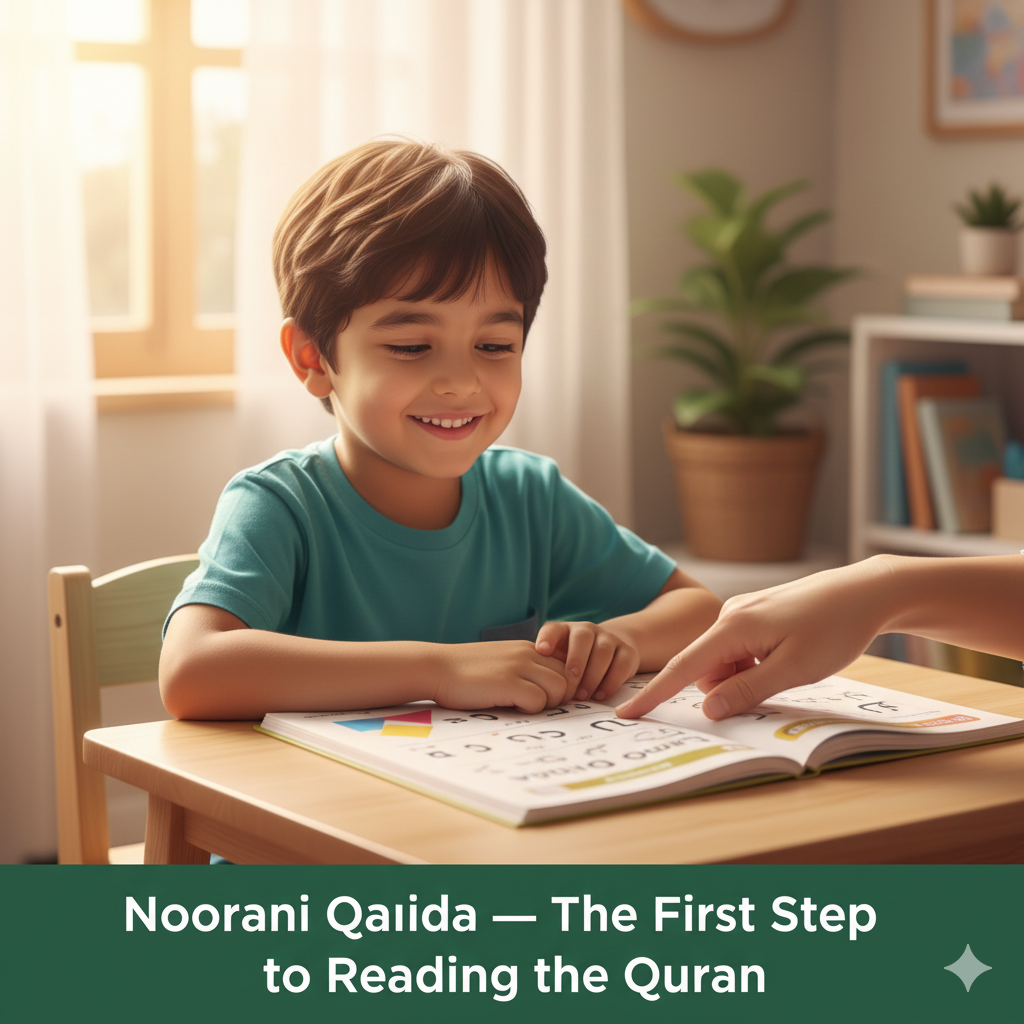
Children as young as four or five can begin the Noorani Qaida as their very first introduction to the Arabic alphabet. At this age, learning through a qualified teacher who makes the sessions interactive and enjoyable is especially important.
Adults who grew up in non-Arabic speaking households and never learned to read Arabic will find the Noorani Qaida to be the clearest and most structured entry point into Quranic reading. Many adult learners are surprised by how quickly they progress once they have the right foundation.
New Muslims who have embraced Islam and want to begin reading the Quran in Arabic will benefit enormously from starting with the Noorani Qaida rather than attempting to read the Quran directly using transliteration.
Even students who already know some Arabic letters but were never taught correctly often benefit from revisiting the Noorani Qaida to fix pronunciation errors before they become deeply ingrained habits.
What Will You Learn in the Noorani Qaida?
The Noorani Qaida is structured in a careful sequence that builds on each lesson before moving to the next. Here is what a student covers:
The Arabic alphabet is the first step. All 29 letters of the Arabic alphabet are introduced with their correct pronunciation, starting from Alif and ending with Ya. Special attention is given to the letters that do not exist in English and require specific points of articulation in the mouth and throat.
Joining letters together comes next. Arabic is a connected script, meaning letters change their shape depending on where they appear in a word — at the beginning, middle, or end. The Noorani Qaida teaches students how letters connect and how to read them in their different forms.
Short vowels (Harakat) are then introduced. The three short vowels — Fathah, Kasrah, and Dhammah — and their effects on how letters are pronounced are a core part of the Qaida. Understanding vowels is essential because the same letter sounds completely different depending on its vowel.
Long vowels and tanween follow. Students learn how to elongate sounds correctly, which is the foundation of the Madd rules they will later study in formal Tajweed.
Sukoon and Shaddah are also covered. Sukoon indicates a letter with no vowel, and Shaddah indicates a doubled letter. Both have specific pronunciation rules that the Noorani Qaida introduces clearly.
Basic Tajweed awareness is woven throughout the Qaida. While it is not a full Tajweed course, the Noorani Qaida introduces students to concepts like Noon Sakinah, Tanween, and Qalqalah in a simple and accessible way that prepares them for formal Tajweed study later.
Noorani Qaida vs Jumping Straight Into the Quran
This is a common debate among parents and adult learners, and the answer from experienced Quran teachers is consistent: skipping the Noorani Qaida almost always creates problems later.
When a student jumps straight into the Quran without proper letter and vowel foundations, several things tend to happen. They mispronounce letters consistently because the correct articulation points were never established. They struggle to read unfamiliar words because the rules of joining letters were never systematically taught. They develop a choppy, hesitant reading style because they are guessing rather than applying learned rules. And crucially, incorrect pronunciation habits form early and become much harder to correct later.
The Noorani Qaida takes these problems off the table entirely. A student who completes it properly arrives at the Quran with confidence, correct pronunciation, and a clear understanding of how Arabic script works. The time invested in the Qaida saves enormous amounts of time and frustration further down the road.
How Long Does It Take to Complete?
The time it takes to complete the Noorani Qaida varies depending on the student’s age, the frequency of lessons, and the pace of the individual learner.
For young children with two to three sessions per week, it typically takes between three and six months to complete the Qaida thoroughly. For motivated adults studying consistently, it can be completed in as little as two to three months. The goal is never to rush through the material but to ensure each section is mastered before moving forward.
A qualified teacher who gives real-time feedback and correction in every session makes a significant difference to how quickly and how correctly a student progresses.
Online Noorani Qaida: Is It Effective?
Absolutely, and in many ways online learning is more effective for the Noorani Qaida than group classroom settings.
In a group class, a teacher cannot listen carefully to every student’s pronunciation in every session. Errors slip through and become habits. In a live one-on-one online class, the teacher’s entire attention is on one student. Every mispronounced letter is caught and corrected immediately. Every question is answered on the spot. And the session can move at exactly the pace that suits that particular learner.
Al-Badry Academy’s Noorani Qaida Course is taught live, one-on-one, by certified native Arabic tutors who specialise in teaching beginners of all ages. Whether you are enrolling your young child or starting your own Quranic journey as an adult, the course is tailored to your specific needs and pace.
Once a student completes the Noorani Qaida, they are fully prepared to move into the Quran Recitation Course, where they begin reading directly from the Quran with proper Tajweed guidance. For younger learners, our dedicated Quran Classes For Kids provide a complete, age-appropriate learning pathway from the Qaida all the way through to memorization and beyond.
You can explore the full range of options on the All Quran Classes page to find what suits your level and goals.
Begin the Right Way From Day One
The Noorani Qaida is not a shortcut or a workaround. It is the correct and proven path to reading the Quran properly. Every minute you invest in it at the beginning will save you hours of correction later and give you a reading foundation that will last a lifetime.
Al-Badry Academy’s certified tutors are ready to guide you or your child through every page of the Noorani Qaida with patience, care, and expertise — all from the comfort of home, at a time that suits your schedule.
Book your free trial class today and take the first step toward reading the Quran the right way.
Explore more: Arabic Classes For Kids Quran Memorization Program View Pricing Plans