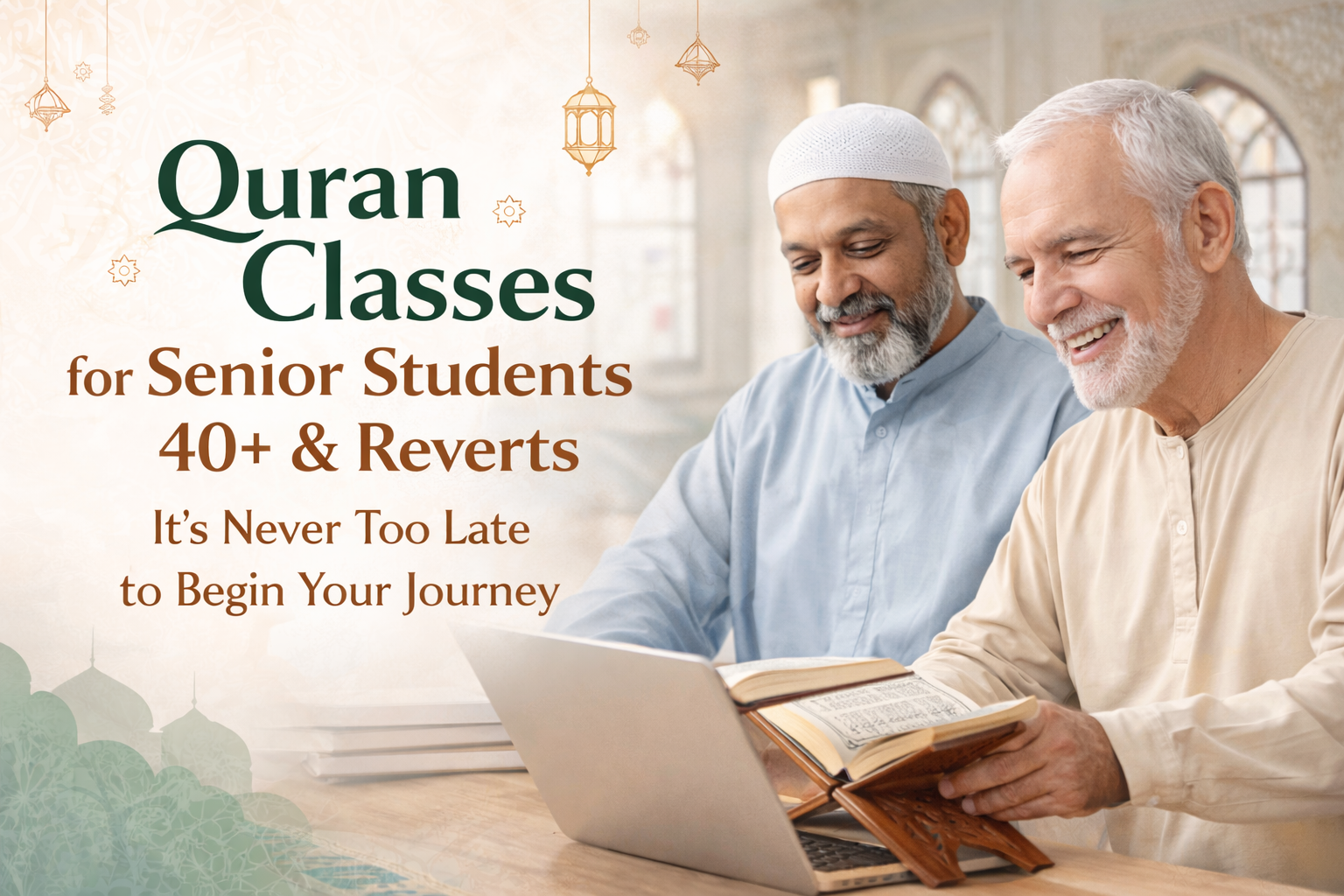

The notion that Quran learning is only for children or young adults represents one of the most damaging misconceptions in Muslim communities today. Countless individuals over 40, whether lifelong Muslims reconnecting with their faith or new converts embracing Islam, postpone or abandon Quran learning because they believe they’re “too old” to start. This belief couldn’t be further from the truth. The reality is that your 40s, 50s, 60s, or even beyond represent not limitations but unique advantages for deep, meaningful engagement with Allah’s words. The maturity, life experience, spiritual hunger, and focused intention you bring as a senior learner create ideal conditions for profound Quranic connection that younger students often lack.
This comprehensive guide addresses everything senior students and reverts need to know about beginning or resuming Quran education later in life. We’ll explore why age actually provides advantages rather than obstacles, how to overcome the specific challenges older learners face, what teaching approaches work best for mature students, and how online platforms have revolutionized accessibility for seniors and converts regardless of location or circumstances. Whether you’re 40, 60, 80, or anywhere in between, whether you’ve been Muslim your entire life or just took Shahada yesterday, this guide shows you exactly how to begin the Quranic journey you’ve been postponing.

Why Senior Students and Reverts Bring Unique Strengths to Quran Learning
Before addressing challenges, understanding the genuine advantages you possess as a mature learner helps reframe “starting late” as “starting at the perfect time.”
Life Experience Creates Deeper Understanding
The Quran addresses universal human experiences including struggle, loss, patience, gratitude, relationships, justice, and purpose. When you’re 20, these concepts remain somewhat abstract. At 40, 50, or 60, you’ve lived them. You’ve experienced difficulties that tested your patience, losses that taught you about grief and healing, relationships that revealed human nature, and challenges that forced growth.
This experiential wisdom means Quranic verses resonate with personal depth impossible for younger students. When you read about sabr (patience), you remember specific trials where patience sustained you. Verses about gratitude connect to blessings you’ve learned to appreciate. Guidance about justice reflects situations where you’ve witnessed fairness and injustice.
Your Quran learning isn’t just academic exercise but conversation with a text that speaks directly to your lived reality. This creates motivation and connection that transcends mechanical memorization or reading practice.
Clarity of Purpose and Focused Intention
Younger students often learn Quran because parents enrolled them or community expectations pressure them. You’re choosing this path consciously, driven by genuine desire rather than external compulsion. This self-directed motivation creates powerful commitment that sustains you through challenges.
For reverts specifically, your deliberate choice to embrace Islam after mature consideration demonstrates intentionality that carries directly into Quranic studies. You’re not inheriting tradition passively but actively claiming spiritual identity. This consciousness infuses every lesson with significance.
Senior students returning after years away similarly possess clarity about why this matters now. Whether motivated by children and grandchildren, approaching mortality’s awareness, or simply spiritual hunger that’s grown over time, your reasons are deeply personal and powerful.
Freedom from Performance Pressure
Younger students often experience social pressure about Quran learning, comparing themselves to peers, worrying about parental approval, or feeling embarrassed by mistakes. As a mature adult, you’re liberated from these anxieties. You’re learning for yourself and Allah, not for anyone else’s approval.
This freedom enables honest engagement with difficulty. When you struggle with pronunciation, you can acknowledge it without shame. When concepts confuse you, you can ask questions without worrying about looking foolish. This psychological safety accelerates learning dramatically.
Appreciation for the Gift of Learning
Having lived decades, you understand how precious the opportunity to learn truly is. Younger students take education for granted; you recognize it as gift. This appreciation creates gratitude that makes you treasure each lesson, practice diligently between sessions, and persist through difficulties rather than quitting when challenged.
Many senior students report that every correctly pronounced letter feels like victory, every memorized verse like treasure, and every moment of understanding like divine gift. This attitude transforms learning from chore into joy.
Understanding and Overcoming Age-Related Learning Challenges
While senior learners possess unique strengths, honesty requires acknowledging specific challenges that come with age and addressing them practically rather than dismissively.
Memory Changes and Adaptation Strategies
The most common concern for senior learners involves memory. It’s true that memorization capacity typically decreases with age compared to childhood peak. However, this doesn’t mean memorization becomes impossible, just different.
Research shows that while rapid memorization slows, comprehension-based memory actually improves with age. Meaningful material that connects to existing knowledge sticks better for older adults than disconnected facts. This means that understanding Quranic meanings through Quran Tafseer Course study or Arabic language learning actually aids rather than hinders memorization for mature students.
Practical adaptations include smaller daily memorization quotas matched to realistic capacity, more repetitions than younger students use, stronger emphasis on understanding meanings before memorizing, systematic review schedules that prevent forgetting, and multi-sensory learning approaches engaging sight, sound, and even writing simultaneously.
The key is abandoning comparison to younger learners and accepting your own pace. You might memorize one verse where a child memorizes five, but your understanding and retention of that single verse might exceed the child’s superficial memorization of their five verses.
Confronting Self-Consciousness and “Too Late” Beliefs
Many senior learners battle internal voices claiming they’re too old to start, should have learned as children, or will never achieve real proficiency. These limiting beliefs create self-fulfilling prophecies where doubt undermines effort.
The antidote is recognizing that the best time to plant a tree was 20 years ago, and the second-best time is today. You cannot change the past, but you absolutely can change your future relationship with the Quran starting right now. History contains countless examples of scholars who began Islamic studies late in life and achieved remarkable mastery.
For reverts, additional challenges include comparing yourself to born Muslims who’ve had lifetime exposure. Remember that quality matters more than duration. A convert who studies with intention and focus for five years often surpasses born Muslims who’ve passively heard Quran for decades without engaging seriously.
Physical Considerations: Vision, Hearing, and Fatigue
Aging brings physical changes affecting learning. Vision changes might make small Arabic text difficult to read. Hearing loss can complicate pronunciation learning if you can’t hear subtle sound distinctions. Energy levels and concentration capacity might be lower than in youth.
These challenges aren’t insurmountable but require accommodation. Use Mushafs with larger text or digital displays you can enlarge. Inform teachers about hearing concerns so they can speak clearly and provide visual pronunciation demonstrations alongside audio. Schedule lessons during times when your energy peaks rather than when you’re tired.
Online learning particularly accommodates these physical needs. You can adjust screen brightness and text size, position yourself optimally for comfort, take breaks as needed, and learn in your own space rather than navigating travel to physical classes.
Building New Neural Pathways in Arabic
Learning any new language challenges adult brains more than children’s neuroplastic minds. Arabic presents particular difficulties with sounds that don’t exist in English, right-to-left reading direction, and completely different script.
However, adult cognitive advantages partially offset neuroplasticity loss. You can understand grammatical explanations that confuse children, apply systematic learning strategies, make conscious connections between related concepts, and maintain discipline through challenges where children give up.
The solution is appropriate expectations and systematic progression. Starting with Noorani Qaida Course foundations gives you time to adapt to Arabic script gradually before tackling actual Quranic text. Patient progression through Quran Reading to Tajweed Rules ensures each skill solidifies before advancing.
Special Considerations for Revert Students
New Muslims face unique circumstances that require understanding beyond what lifelong Muslims experience when beginning formal Quran studies.
Starting from Absolute Zero
Unlike Muslims raised in the faith who’ve at least heard Quranic recitation throughout life, reverts often begin with zero exposure to Arabic, Islamic concepts, Quranic context, or Muslim practice. Everything is simultaneously new, which can feel overwhelming.
This apparent disadvantage actually provides advantage in one crucial way: you have no bad habits to unlearn. Lifelong Muslims often carry incorrect pronunciation learned from unqualified community members or misunderstandings about Islamic concepts absorbed through osmosis. You’re building on clean foundations.
The New Muslim Course and New Shahada Classes specifically address revert needs by providing comprehensive foundations before diving into pure Quran study. These courses explain basic Islamic beliefs, practices, and concepts that lifelong Muslims assume everyone knows, creating the contextual framework that makes subsequent Quran learning meaningful.
Balancing Quran Learning with Basic Islamic Education
Reverts face a unique challenge of needing to learn multiple things simultaneously. You need basic Islamic knowledge for daily practice, prayer requirements for the five daily prayers, Quranic recitation for use in those prayers, and deeper theological understanding to solidify your faith foundations. Trying to learn everything at once creates overwhelming paralysis.
The solution is strategic prioritization and integrated learning. Focus initially on what you need immediately for daily practice through courses like Prayer (Namaz) and Wudu while beginning foundational Quran reading skills. As these stabilize, expand into deeper study through Islamic Classes for Adults covering aqeedah, fiqh, and other essential knowledge.
Your Quran learning progresses in parallel with broader Islamic education rather than waiting until you’ve mastered everything else. Many reverts find that Quranic study and Islamic knowledge reinforce each other, with each deepening understanding of the other.
Navigating Cultural vs. Religious Elements
Reverts often struggle distinguishing between actual Islamic requirements and cultural practices that Muslims from specific backgrounds present as religious obligations. This confusion extends to Quran learning, where cultural methods might be presented as the only “correct” approach.
Recognize that while Quranic content is unchanging, teaching methods vary considerably across cultures. South Asian approaches differ from Arab approaches differ from African approaches. None is inherently “right” while others are “wrong.” What matters is qualified instruction following authentic Islamic principles, regardless of cultural packaging.
Online learning through diverse platforms like Albadry Academy provides exposure to multiple qualified teachers from various cultural backgrounds, helping you distinguish universal Islamic principles from culture-specific practices. This diversity benefits reverts tremendously by preventing conflation of one culture with Islam itself.
Finding Community and Support
Reverts often feel isolated, particularly if they’re the only Muslim in their family or local social circle. This isolation can extend to Quran learning, where you might feel you lack the cultural context and community support that born Muslims enjoy.
Online learning communities actually benefit reverts by connecting you with diverse Muslims worldwide who share your learning journey. You’re not limited to whatever local community exists but can find specific revert support groups, study circles, and fellow learners who understand your unique experience.
Many academies facilitate these connections through student forums, group review sessions, or connecting students at similar levels for mutual support and accountability.
Teaching Approaches That Work Best for Senior and Revert Students
Not all Quran teaching methods serve mature learners equally well. Understanding which approaches work best helps you choose appropriate programs and communicate your needs clearly to teachers.
One-on-One Instruction vs. Group Classes
While group classes offer community and lower costs, individual instruction dramatically better serves senior learners and reverts for several reasons. The pace adapts completely to your specific speed without pressure to keep up with faster learners or waiting for slower ones. Teachers can address your particular challenges and questions thoroughly rather than managing group dynamics. You can ask “basic” questions without embarrassment about your age or revert status. Lessons focus entirely on your goals rather than average group needs.
For seniors who tire more easily than younger students, individual lessons can be shorter and more frequent rather than long group sessions that exhaust concentration capacity. For reverts with zero background, individual attention ensures foundational gaps get addressed rather than assuming prior knowledge everyone else possesses.
The investment in individual instruction pays dividends through dramatically faster progress, better retention, and more enjoyable learning experience that keeps you motivated long-term.
Emphasis on Understanding Over Memorization
While memorization holds value, senior learners particularly benefit from emphasis on understanding meanings, context, and application over pure memorization. Your cognitive strengths lie in comprehension and connection-making rather than raw memorization capacity.
Learning through Quran Tafseer Course that explains verses in depth or Quranic Arabic Course that enables direct understanding creates meaningful engagement that aids rather than replaces memorization. When you understand what verses mean, memorization becomes natural byproduct rather than forced effort.
This approach also serves reverts who need contextual understanding to prevent misinterpretation of verses isolated from their proper meaning. Understanding prevents the dangerous practice of cherry-picking verses to support preconceived notions rather than submitting to the Quran’s actual message.
Patience and Encouragement Over Pressure
Senior learners and reverts need teaching approaches prioritizing encouragement and patience over pressure and comparison. Teachers who celebrate small victories, acknowledge the courage it takes to start later in life, understand emotional vulnerability reverts experience, and maintain realistic expectations about progress timelines create environments where mature students thrive.
Avoid teachers or programs employing shame-based motivation, making unfavorable comparisons to younger or more advanced students, maintaining rigid timelines regardless of individual capacity, or displaying impatience with questions or slower progress.
Quality teachers recognize that your journey is uniquely yours, progressing at exactly the right pace for your circumstances and capacity. They measure success by your growth compared to your starting point, not by arbitrary external standards.
Integration of Islamic Context and Application
Mature learners benefit tremendously from instruction that doesn’t isolate Quran reading from broader Islamic knowledge and practical application. Understanding how verses apply to daily challenges, how they connect to other Islamic teachings, and how scholars have interpreted them across centuries creates rich engagement impossible with decontextualized reading practice.
This integrated approach particularly serves reverts who need to build comprehensive Islamic understanding rather than just technical reading skills. Courses like Islamic Classes for Adults, Hadith Course, and Fiqh Course complement Quran study by providing the contextual framework that makes Quranic guidance practically actionable.
Why Online Learning Particularly Benefits Seniors and Reverts
Technology might seem counterintuitive for older learners, but online Quran classes actually address senior and revert needs better than traditional methods in most cases.
Eliminating Mobility and Transportation Barriers
As we age, traveling to physical classes becomes increasingly challenging. Health conditions, transportation limitations, weather concerns, or simple fatigue from work all create barriers to attending in-person classes regularly. Missing classes creates gaps that make progress difficult.
Online learning eliminates these barriers entirely. Your Quran class comes to you, accessible from your living room, requiring no commute, no exposure to weather, no physical exertion beyond sitting comfortably at your device.
This accessibility proves crucial for reverts without local mosques or Islamic centers, those living in areas where Quran classes don’t exist, and anyone with physical limitations that make travel difficult.
Privacy and Comfort for Anxious Beginners
Many seniors feel self-conscious about being older beginners, worried they’ll stand out in classes full of younger students or that people will judge them for starting “so late.” Reverts similarly often feel vulnerable as new Muslims learning basics that everyone else seems to know.
Online one-on-one learning provides complete privacy. Only your teacher sees your struggles, mistakes, and questions. You can make errors without public embarrassment, ask seemingly “stupid” questions without judgment, and progress at your pace without comparing yourself visibly to other students.
This private environment removes psychological barriers that prevent many seniors and reverts from ever beginning their Quran journey despite genuine desire.
Flexible Scheduling for Busy or Unpredictable Lives
Retirement doesn’t mean empty calendars. Many seniors juggle grandchildren care, volunteer work, medical appointments, or travel. Working seniors balance careers with learning goals. Reverts often navigate complex family situations where Muslim education happens around non-Muslim household schedules.
Online platforms offer scheduling flexibility impossible in traditional settings. You choose lesson times that actually work for your life, whether early morning, late evening, weekends, or unconventional hours. When disruptions occur, rescheduling doesn’t mean permanently falling behind but simply adjusting to next available time.
Access to Specialized Teachers Globally
Your local area might not have teachers specifically experienced with senior students or revert needs. Online learning eliminates geographic limitations, connecting you with teachers worldwide who specialize exactly in serving mature learners and converts.
Albadry Academy serves students across the USA, UK, Canada, Australia, and Europe through certified native Arab instructors trained specifically in adult education and revert teaching. You’re not limited to whoever happens to be available locally but can select from teachers specifically qualified for your unique situation.
Practical Steps to Begin Your Quran Journey Today
Understanding why starting later in life is absolutely possible matters, but taking concrete first steps transforms understanding into action.
Start with Realistic Assessment and Goal-Setting
Before beginning, honestly assess where you are and what you want to achieve. Are you a complete beginner who cannot read any Arabic? Can you read but want to improve Tajweed? Do you want to memorize specific Surahs or understand meanings? Is your goal basic prayer recitation or comprehensive Quranic mastery?
Clear goals enable appropriate course selection and realistic timeline expectations. A 50-year-old complete beginner aiming to memorize the entire Quran faces a decades-long journey requiring full commitment. That same person aiming to read fluently with proper Tajweed might achieve their goal within two years of consistent study.
Neither goal is wrong, but clarity about what you’re actually attempting to accomplish prevents discouragement from unrealistic expectations.
Begin with Proper Foundations
If you’re starting from zero, resist temptation to skip foundations in eagerness to reach “real” Quran reading. Proper progression through Noorani Qaida Course that teaches Arabic alphabet, letter formation, and basic reading rules creates essential foundations that make everything subsequent easier.
Rushing past foundations creates problems that require going back later anyway, wasting time you could have spent building correctly from the start. Patient foundation-building feels slow initially but accelerates long-term progress dramatically.
Experience Quality Instruction Through Trial Classes
Don’t commit to any program without experiencing their teaching directly. Book a free trial at Albadry Academy to meet qualified teachers, experience their approach to mature learners, assess whether their teaching style suits you, and determine if online learning feels comfortable.
During trials, evaluate whether the teacher seems patient and encouraging, whether explanations are clear and adapted to your level, whether you feel comfortable asking questions, and whether the technology works smoothly for your setup.
Commit to Consistency Over Intensity
As a mature learner, consistency matters infinitely more than intensity. Daily 20-minute practice produces better results than occasional two-hour sessions. Regular twice-weekly lessons sustained over months outperform intensive daily lessons you burn out on after weeks.
Build Quran learning into your routine as non-negotiable appointment with yourself and Allah. Treat lesson times and practice periods with the same seriousness you’d treat doctor appointments or important work commitments.
Why Albadry Academy Serves Senior and Revert Students Exceptionally
Among online Quran platforms, Albadry Academy has built strong reputation specifically for serving mature learners and converts through several distinguishing factors.
Teachers Trained in Adult Education
All Albadry instructors receive specific training in teaching adults, not just children. They understand that explaining concepts to mature learners requires different approaches than teaching kids. They maintain patience with age-related challenges while respecting your intelligence and life experience.
Their certified native Arab teachers hold proper credentials and ijazah while also possessing communication skills and cultural sensitivity essential for working with Western students and new Muslims navigating unfamiliar territory.
Comprehensive Course Offerings
Whether you need absolute beginner foundations through Noorani Qaida, reading development through Quran Reading Course, pronunciation refinement through Tajweed Rules, or deeper understanding through Quran Tafseer, comprehensive offerings mean you don’t need to switch platforms as needs evolve.
For reverts specifically, New Muslim Course and broader Islamic Classes for Adults provide contextual Islamic knowledge that complements Quran study.
Flexible, Accommodating Scheduling
Understanding that mature students have complex lives, Albadry offers exceptional scheduling flexibility across multiple timezones. Whether you’re in the USA, UK, Canada, Australia, or elsewhere, you’ll find convenient times. Their rescheduling policy acknowledges that life happens, particularly for seniors managing health appointments and family obligations.
Risk-Free Trial Opportunity
Before any financial commitment, you can experience Albadry’s approach directly. This trial demonstrates their confidence in quality while allowing you to assess fit without risk.
Taking Your First Step: You’re Not Too Old, and It’s Not Too Late
If you’re reading this and you’re over 40, whether you’ve been Muslim your whole life or you’re newly embracing Islam, hear this truth clearly: You are absolutely not too old to begin learning Quran. Every day you postpone waiting for “the right time” or “when you’re ready” is another day without the profound connection to Allah’s words that awaits you.
The Prophet Muhammad (peace be upon him) began receiving revelation at age 40. Your 40s, 50s, 60s, or beyond don’t represent endings but beautiful new beginnings. The maturity, wisdom, and spiritual hunger you bring as a senior learner create ideal conditions for deep, transformative engagement with the Quran.
Don’t let fear, self-consciousness, or limiting beliefs about age rob you of this gift. Book your free trial with Albadry Academy today and take that crucial first step. Meet qualified teachers who specialize in serving students exactly like you. Experience how online learning accommodates your needs perfectly. Discover that starting your Quran journey right now, today, at whatever age you are, represents perfect timing.
Your relationship with the Quran doesn’t have expiration dates or age limits. It begins whenever you decide to begin, and every moment you invest in learning brings you closer to Allah regardless of how many years you’ve lived. Start today. Trust that Allah facilitates the path for those who sincerely seek knowledge of His book. And know that the angels celebrate every letter you learn, every verse you recite, and every effort you make toward understanding His words, regardless of your age or how recently you embraced Islam.
May Allah bless your learning journey, grant you consistency and patience, reward your courage in starting despite age-related fears, and make the Quran a source of light, guidance, and comfort throughout your remaining years and into eternity.