
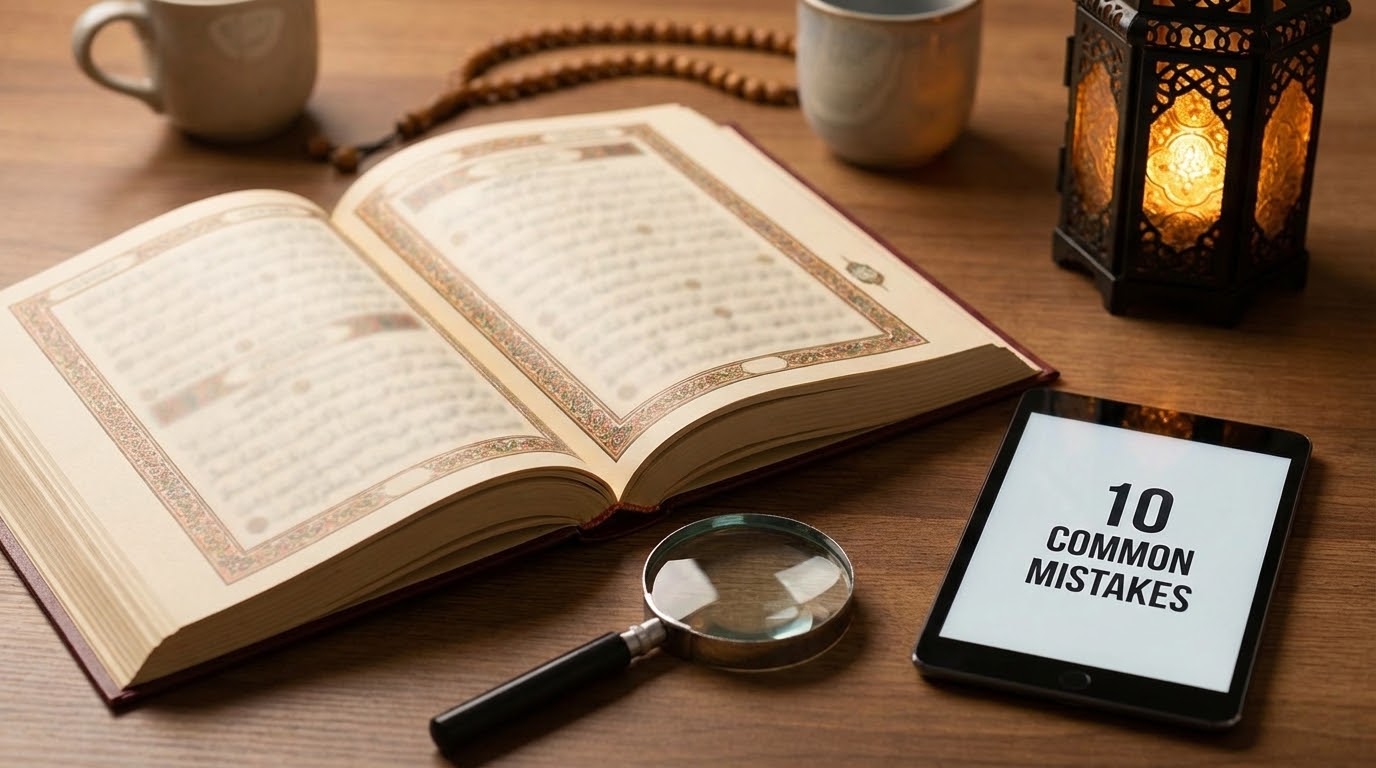

10 common tajweed mistakes that actually change quran meanings and how to fix them
Reciting the Quran beautifully is a cherished goal for every Muslim, but what many don’t realize is that certain Tajweed mistakes go beyond sounding incorrect. They actually alter the meaning of Allah’s words. A mispronounced letter or incorrect vowel can transform a verse about mercy into something entirely different, or change a command into a question.
Understanding these critical errors and learning to avoid them isn’t just about perfecting your recitation. It’s about preserving the integrity of divine revelation and ensuring that when you recite, you’re conveying exactly what Allah intended. This comprehensive guide identifies the most common Tajweed mistakes that change meanings and provides clear solutions to help you recite with confidence and accuracy.
Why Tajweed Matters More Than You Think
Before diving into specific mistakes, it’s essential to understand why Tajweed rules exist in the first place. The Quran was revealed in Arabic with precise pronunciation, and the early Muslims were meticulous about preserving every subtle nuance. When Islam spread to non-Arabic speakers, scholars developed Tajweed rules to ensure the Quran would be recited correctly across all cultures and generations.
The Prophet Muhammad (peace be upon him) emphasized the importance of Quran recitation and encouraged believers to learn it properly. Those who strive to recite correctly, even when it’s difficult, are rewarded for their sincere effort.
Many Muslims grow up reciting the Quran by memory or imitation without formal Tajweed training. While their intention is pure and their recitation may sound pleasant, they often perpetuate mistakes learned from parents or community members who also lacked formal training. Breaking this cycle requires honest assessment of your current recitation and commitment to structured learning with qualified teachers.
Mistake #1: Confusing Heavy and Light Letters (Tafkheem vs Tarqeeq)
One of the most fundamental yet frequently made errors involves the distinction between heavy (Tafkheem) and light (Tarqeeq) pronunciation. Certain Arabic letters must be pronounced with a “thick” or “full” sound, while others require a “thin” or “light” articulation. Mixing these up doesn’t just sound wrong. It can completely change word meanings.
The clearest example involves the letter “Saad” (ص) versus “Seen” (س). These letters look similar and occupy the same position in words, but pronouncing them incorrectly creates different words with different meanings. Consider the word “صِرَاطَ” (Siraata) in Surah Al-Fatiha, which means “the path.” If you pronounce the heavy “Saad” as a light “Seen,” you’re saying “سِرَاطَ” which isn’t even a proper Arabic word and completely distorts the verse’s meaning.
Similarly, the letter “Daad” (ض) must be pronounced heavily, not confused with “Daal” (د). In Surah Al-Asr, “وَالْعَصْرِ” (Wal-Asr) contains a heavy “Saad.” Pronouncing it lightly changes the entire meaning from “by time” to something nonsensical. These aren’t minor aesthetic issues. They’re fundamental errors that alter divine text.
The challenge is that many non-native Arabic speakers struggle to hear the difference between heavy and light letters, let alone produce them correctly. This is precisely why learning with a qualified teacher who can model correct pronunciation and provide immediate feedback becomes invaluable. Self-study from books or videos often fails here because you can’t assess your own articulation accurately without external feedback.
Practicing with structured Tajweed courses that focus specifically on articulation points (Makharij) trains your mouth and ears simultaneously. You learn where to position your tongue, how to shape your mouth, and how to recognize the correct sound when produced properly. This foundational skill affects virtually every verse you’ll ever recite.
Mistake #2: Incorrect Vowel Lengths (Madd)
Arabic has short vowels, long vowels, and even ultra-long vowels depending on context. These aren’t optional variations for stylistic preference. They’re mandatory rules that when violated, change meanings dramatically. The term “Madd” refers to elongation, and applying the wrong length or skipping elongation entirely creates serious errors.
Consider the difference between “مَا” (maa) meaning “what” or “that which” and “مَ” (ma) without elongation, which doesn’t convey complete meaning. In Surah Al-Ikhlas, “قُلْ هُوَ اللَّهُ أَحَدٌ” (Qul Huwa Allahu Ahad), if you don’t properly elongate “Huwa,” you’ve rushed through a fundamental statement about Allah’s oneness. While the meaning might still be understood, you haven’t fulfilled the recitation requirement properly.
More seriously, incorrect Madd can create confusion about negations and affirmations. The difference between a short and long vowel can determine whether a verse is stating something positively or negatively. Some words only make grammatical sense when vowel length is correct, and rushing through or over-extending creates linguistic impossibilities.
There are multiple types of Madd, each with specific rules: natural Madd (2 counts), connected Madd (4-5 counts), separate Madd (4-5 counts), and necessary Madd (6 counts). Many reciters know they should “stretch” certain letters but don’t understand how long or why. This leads to inconsistent recitation where they sometimes elongate correctly and sometimes don’t, depending on how the person they learned from recited that particular verse.
The solution involves systematic learning of each Madd type with counted beats. In Al-Badry Academy’s approach, students practice with metronomes or counting methods until proper elongation becomes second nature. This isn’t about becoming rigid or mechanical. It’s about training your natural recitation to automatically apply correct lengths without conscious thought.
Mistake #3: Skipping or Adding Shaddah (Doubling)
The Shaddah mark (ّ) indicates that a letter should be doubled or emphasized. This isn’t a suggestion for dramatic effect. It’s a grammatical necessity that changes verb tenses, noun forms, and ultimately meanings. When you see Shaddah, you must pronounce that letter twice: once to end the preceding syllable and once to begin the next.
A common mistake occurs with the word “رَبِّ” (Rabbi) meaning “my Lord.” The double “baa” with Shaddah must be pronounced clearly. If you pronounce it as a single “baa” saying “رَبِي” (Rabi), you’ve changed it from “my Lord” (Rabbi) to “my spring” (Rabi) or made it grammatically incorrect. In prayer and Quran recitation, calling Allah “my spring” instead of “my Lord” is obviously problematic.
Another frequent error involves “إِنَّ” (Inna) versus “إِنْ” (In). “Inna” with doubled “noon” is an emphasis particle meaning “indeed” or “verily.” “In” without doubling is a conditional particle meaning “if.” These are completely different words with different grammatical functions. Mixing them up doesn’t just sound wrong; it makes verses grammatically incorrect and can reverse meanings from statements of certainty to conditional possibilities.
The challenge with Shaddah is that it requires precise timing and tongue coordination. You must stop the sound briefly between the doubled letters without inserting an extra vowel. Many students either skip the doubling entirely, making it a single letter, or over-compensate by creating such a long pause that it sounds unnatural.
Practicing Shaddah specifically, with slow, deliberate recitation focused on these doubled letters, helps develop muscle memory. Start with individual words containing Shaddah, practice them in isolation until correct, then integrate them into full verse recitation. This progressive approach, emphasized in comprehensive Quran recitation programs, ensures you master the technique before applying it to faster-paced reading.
Mistake #4: Wrong Letter Articulation Points (Makharij)
Every Arabic letter has a specific place in the mouth, throat, or lips where it must be articulated. Pronouncing letters from incorrect articulation points creates different letters entirely. Since the Quran uses the full range of Arabic phonetics, incorrect Makharij doesn’t just make your recitation sound odd. It transforms words into different words or nonsense sounds.
The letters “ح” (Haa) and “ه” (Haa) present a classic example. Though both are transliterated as “H” in English, they’re completely different sounds in Arabic. “ح” comes from the middle of the throat with a breathy, harsh sound, while “ه” comes from the furthest throat point with a softer sound. In Surah Al-Ikhlas, “أَحَدٌ” (Ahad) meaning “One” uses “ح”. If you pronounce it with “ه” saying “أَهَدٌ” you’ve created a meaningless word.
Similarly, “ع” (Ayn) and “أ” (Hamza) both involve the throat but at different points and with different characteristics. “ع” is a deep, constricted sound from the middle throat, while “أ” (Hamza) is a sharp glottal stop. Many non-Arabic speakers struggle with “Ayn” and substitute “Alif,” completely changing words. “علم” (Ilm – knowledge) becomes “الم” if you remove the proper Ayn articulation, creating either a different word or linguistic confusion.
The throat letters (“ح” “خ” “ع” “غ” “ه” and Hamza) cause the most difficulty because English and many other languages don’t utilize these throat articulation points. Your throat muscles literally aren’t trained for these sounds unless you’ve been speaking Arabic from childhood or have undertaken specific training. This isn’t something you can learn from written descriptions alone.
Working one-on-one with qualified teachers who can observe your mouth position, tongue placement, and throat movement makes the crucial difference. Video-based learning has limitations here because you can’t self-assess whether you’re articulating from the correct point. Online Quran classes with live teacher interaction provide the immediate correction necessary to develop proper Makharij.
Mistake #5: Incorrect Noon Sakinah and Tanween Rules
Noon Sakinah (نْ – a noon without a vowel) and Tanween (the double vowel marks ً ٌ ٍ) follow specific rules depending on what letter comes after them. These rules – Izhaar, Idghaam, Iqlab, and Ikhfa – aren’t optional stylistic choices. They’re mandatory grammatical requirements that affect meaning and must be applied consistently.
Izhaar requires clear pronunciation of Noon Sakinah or Tanween when followed by throat letters. Many reciters incorrectly nasalize or hide the noon sound here, making the recitation grammatically incorrect. For example, in “مِنْ أَهْلِ” (min ahli), the noon must be pronounced clearly before the “alif,” not hidden or merged.
Idghaam involves merging Noon Sakinah or Tanween into the following letter when that letter is one of six specific letters (ي ر م ل و ن). The most common mistake is pronouncing both letters separately when they should be merged, or vice versa. In “مَن يَعْمَلْ” (man ya’mal), the noon merges into the yaa, but many reciters keep them separate, creating a pronunciation that no Arabic speaker would use in natural speech.
Iqlab (converting) happens specifically when Noon Sakinah or Tanween is followed by “baa” (ب). You must convert the noon sound to a “meem” sound with lip closure. Missing this rule is extremely common. In “مِنۢ بَعْدِ” (min ba’di), the noon converts to meem sound before baa, creating a nasalized “m” sound rather than a clear “n” followed by “b.”
Ikhfa (hiding) applies to the remaining letters – around 15 letters where Noon Sakinah or Tanween is partially hidden through nasalization. The exact degree of hiding varies by letter, creating a subtle pronunciation that many students struggle to master. This is neither full pronunciation (Izhaar) nor complete merging (Idghaam), but something in between that requires careful teacher guidance.
These rules exist in every page of Quran, often multiple times per verse. Reciting without knowing or applying them means virtually every few words contains an error. This is why structured Tajweed education isn’t optional luxury. It’s fundamental necessity for anyone wanting to recite Quran correctly.
Mistake #6: Qalqalah Letters Without Bouncing
Qalqalah refers to a “bouncing” or “echoing” sound that must occur with five specific letters (ق ط ب ج د) when they have no vowel (sukoon). This isn’t about adding extra sound or dramatizing your recitation. It’s a linguistic requirement that affects how these letters function in words and sentences.
The Qalqalah effect happens because these five letters are pronounced from specific points with complete closure or stoppage. When that closure releases on a vowel-less letter, it creates a natural bounce. Suppressing this bounce or not pronouncing it properly makes your recitation incorrect and can blur word boundaries, making it harder for listeners to distinguish between words.
Consider “أَحَد” (Ahad) in Surah Al-Ikhlas. The “daal” at the end requires Qalqalah because it has sukoon and the verse stops there. Without the bounce, the word sounds flat and incomplete. Similarly, in “يَغْفِرْ” (yaghfir), the final “raa” with sukoon requires attention to ensure it doesn’t accidentally acquire Qalqalah (since “raa” isn’t one of the five letters), while if there were a Qalqalah letter in that position, it would need the bounce.
There are two types of Qalqalah: minor (when the letter appears in the middle of a word) and major (when it appears at the end of a word where you stop). Major Qalqalah requires a more pronounced bounce. Many reciters either apply no Qalqalah at all or apply it inconsistently, sometimes bouncing and sometimes not, depending on whether they remember the rule in that moment.
The solution involves targeted practice with each of the five letters in various positions. Start by exaggerating the bounce to ensure you’re producing it, then gradually make it more natural. Record yourself and compare to professional reciters, or better yet, practice with a teacher who can confirm you’re applying Qalqalah correctly in all positions.
Mistake #7: Running Words Together (Waqf and Ibtida)
Knowing where to stop breathing (Waqf) and where to resume (Ibtida) isn’t just about breath management. The rules of stopping and starting affect meaning significantly. Stopping at the wrong place can connect phrases that should be separate or separate phrases that should be connected, completely altering verse meanings.
Knowing where to stop breathing (Waqf) and where to resume (Ibtida) isn’t just about breath management. The rules of stopping and starting affect meaning significantly. Stopping at the wrong place can connect phrases that should be separate or separate phrases that should be connected, completely altering verse meanings.
The Quran has specific marking symbols indicating where stopping is required, recommended, or prohibited, but many reciters either don’t know these symbols or ignore them for breath convenience.
The prohibition symbol (لا) means you absolutely cannot stop at that point because doing so would create incorrect meaning or incomplete thought. Yet beginners often stop wherever they run out of breath, inadvertently creating theological errors or grammatical impossibilities. In contrast, some places have the recommended stopping symbol (قلى or ج) where pausing is encouraged because it completes a thought.
A common mistake involves stopping at the end of physical lines in the mushaf rather than at meaning-based stopping points. The Quran’s line breaks in printed copies are for page layout, not breathing indicators. Stopping just because you reached the line’s end often breaks apart phrases that should remain connected.
Learning proper Waqf and Ibtida requires studying the marking system used in your mushaf (different prints use slightly different symbols) and understanding the grammatical reasons behind each marking. This goes beyond Tajweed into Arabic grammar knowledge, which is why comprehensive Islamic studies that combine Tajweed with basic grammar provide the most complete foundation.
Mistake #8: Incorrect Raa Letter (Heavy vs Light)
The letter “raa” (ر) presents unique challenges because unlike other letters that are always heavy or always light, “raa” changes between heavy (Tafkheem) and light (Tarqeeq) pronunciation depending on the vowels and letters around it. Determining which pronunciation to use requires knowing specific rules that many reciters never learned formally.
Generally, “raa” is heavy when it has a fatha (َ) or damma (ُ) vowel, or when it’s sukoon (vowelless) preceded by fatha or damma. It becomes light when it has kasra (ِ) or when it’s sukoon preceded by kasra. However, exceptions exist that complicate these basic rules, particularly involving Alif letters and word positions.
In “الرَّحْمَٰنِ” (Ar-Rahman), the “raa” is heavy despite the kasra underneath because the fatha on the following letter “haa” influences it. But in “الرَّحِيمِ” (Ar-Raheem), the “raa” becomes light because of the kasra and the following “yaa.” These nuances within the same frequently-recited verses create confusion for students who try to memorize pronunciation without understanding underlying rules.
More complex situations arise with words like “فِرْعَوْنَ” (Fir’awn – Pharaoh) where the sukoon “raa” preceded by kasra would normally be light, but is actually heavy because of the specific word structure. Without formal training, reciters either default to always heavy “raa” (safer but sometimes wrong) or always light (definitely wrong in many cases), rather than applying correct rules.
The solution requires systematic study of “raa” rules with multiple examples of each scenario. This letter alone deserves dedicated practice time because it appears so frequently and its rules are so nuanced. Working through structured Tajweed programs that address “raa” specifically, with practice exercises and teacher correction, ensures you develop intuitive sense for when “raa” should be heavy versus light.
Mistake #9: Lam in “Allah” – The Most Recited Error
The name “Allah” (اللّٰه) contains one of the most frequently mispronounced elements in Quran recitation: the “lam” (ل) letter. Whether this “lam” should be heavy or light depends on the vowel of the letter before it, yet many Muslims recite it consistently one way regardless of context, creating persistent errors in virtually every verse containing Allah’s name.
The rule is straightforward: if the letter before “Allah” has fatha or damma, the “lam” in “Allah” is heavy (thick). If the letter before has kasra, the “lam” is light (thin). Yet countless Muslims always pronounce it heavy or light without variation, not realizing context determines the correct pronunciation.
In “بِسْمِ اللَّهِ” (Bismillah), the “meem” before Allah has kasra, making the “lam” light. But in “قَالَ اللَّهُ” (qaala Allahu), the “alif” before Allah has fatha context, making the “lam” heavy. These aren’t subtle variations that only experts notice. They’re clear, audible differences that affect whether you’re pronouncing Allah’s name correctly in that specific context.
The challenge is that most people learn “Bismillah” and other common phrases by rote imitation, then apply that same pronunciation to Allah’s name everywhere without adjusting for context. Breaking this habit requires conscious attention each time you recite Allah’s name, checking what vowel preceded it and adjusting your “lam” accordingly.
This particular rule is so important because you’re pronouncing Allah’s name. While Allah accepts our efforts and forgives our mistakes, striving for correct pronunciation of His name shows respect and care. Dedicating specific practice to recognizing and correctly pronouncing the “lam” in various contexts demonstrates seriousness about Quranic recitation.
Mistake #10: Idghaam Mithlain (Merging Identical Letters)
When two identical letters meet – the first with sukoon and the second with any vowel – they must merge into one emphasized letter. This rule, called Idghaam Mithlain, occurs frequently but is often missed or incorrectly applied. The result is either choppy, incorrect pronunciation or a loss of the emphasis that the rule is meant to preserve.
A clear example appears in “اذْهَب بِّكِتَابِي” (idh-hab bi-kitabi). The “baa” at the end of “hab” meets the “baa” beginning “bi-kitabi,” creating doubled “baa” that must be pronounced with Shaddah emphasis. Many reciters pronounce both “baa” letters separately, creating “hab bi” instead of the correct merged “hab-bi” with emphasis.
Similarly, with the phrase “قَد دَّخَلُوا” (qad dakhalu), the “daal” at the end of “qad” merges with the “daal” beginning “dakhalu.” Keeping them separate sounds choppy and grammatically incorrect. The merging creates a smooth, emphasized transition that marks proper Arabic pronunciation.
The mistake often happens because students look at the written text and see two separate letters, so they pronounce them separately. They don’t realize that the Quranic text deliberately keeps them separate visually while the pronunciation rules require merging. This disconnect between visual appearance and pronunciation rules creates persistent errors.
Learning to recognize when Idghaam Mithlain applies requires understanding sukoon and vowel patterns. You need to identify: (1) Is this letter vowel-less? (2) Is the next letter identical? (3) Does the next letter have a vowel? If all three conditions exist, merging is mandatory. Practicing this recognition with qualified instructors who can point out these patterns as they appear throughout the Quran builds the pattern recognition needed for automatic correct application.
How to Systematically Fix Your Tajweed Errors
Understanding these common mistakes is the first step, but knowing about errors doesn’t automatically correct them. Building correct Tajweed requires systematic approach combining knowledge, practice, and feedback. Here’s how to address these issues effectively.
Start by recording yourself reciting familiar verses – perhaps Al-Fatiha and the last few surahs of the Quran. Listen back critically, or better yet, have someone knowledgeable listen and identify which of these ten mistakes appear in your recitation. Most people discover they’re making 4-6 of these errors regularly, often without ever realizing it.
Once you know your specific problem areas, prioritize them. If you’re confusing heavy and light letters, that’s foundational and affects everything else. If your Waqf and Ibtida are weak but your letter articulation is good, focus on stopping and starting rules. Strategic targeting of your weakest areas yields faster overall improvement than trying to fix everything simultaneously.
Work with qualified teachers who can provide real-time correction. Self-study from books and videos has its place for understanding concepts, but correcting pronunciation requires someone to hear you and provide immediate feedback. Online learning through platforms like Al-Badry Academy makes accessing qualified teachers convenient regardless of your location, with flexible scheduling that fits around work and family obligations.
Practice slowly and deliberately at first. Speed comes naturally once accuracy is established, but trying to recite quickly before mastering correct pronunciation just reinforces errors at faster pace. Spend time on individual words, then phrases, then complete verses, ensuring each level is correct before progressing to the next.
Building Long-Term Tajweed Excellence
Correcting Tajweed errors isn’t a one-time fix. It’s an ongoing journey of refinement that continues throughout your life. Even accomplished reciters periodically review fundamentals with teachers to ensure they haven’t developed any lazy habits or overlooked mistakes creeping into their recitation.
Make Tajweed review part of your regular Quran routine. Dedicate one day weekly to focused Tajweed practice rather than general reading. Choose specific rules or problem areas, work through verses that highlight those issues, and consciously apply correct pronunciation. This regular maintenance prevents backsliding and continues advancing your skill.
Listen extensively to expert reciters, not just for enjoyment but for learning. Choose reciters known for impeccable Tajweed like Sheikh Husary, Sheikh Minshawi, or Sheikh Al-Ghamdi. Play their recitation repeatedly while following along in your mushaf, noticing how they handle the exact scenarios where you struggle. This combination of hearing correct models and analyzing your own recitation accelerates improvement.
Consider pursuing formal certification (Ijazah) in Quran recitation if you’re serious about excellence. This traditional system connects you through a chain of authenticated teachers back to the Prophet (peace be upon him), ensuring your recitation meets the highest standards. While not everyone needs Ijazah, working toward it provides structured goals and expert validation of your progress.
Why Professional Learning Makes the Difference
Many Muslims resist formal Tajweed education, thinking: “I’ve been reciting for years, how bad can it be?” or “I’ll just watch some YouTube videos.” While self-motivation is admirable, most people dramatically underestimate how many errors their recitation contains and overestimate their ability to self-correct through video learning alone.
Professional instruction through programs like those offered at Al-Badry Academy provides several irreplaceable benefits: immediate correction of errors you can’t hear yourself making, systematic coverage of all rules rather than random topics, accountability that maintains consistent practice, and cultural/linguistic context that books and videos can’t convey.
The investment in proper Tajweed education pays dividends throughout your life. Every prayer becomes more correct, every Quran reading more accurate, every teaching moment with your children more authoritative. You’re not just learning rules. You’re becoming a living link in the chain of Quranic preservation that has protected Allah’s words for 1,400 years.
Current special offers with 20% discount make professional instruction more accessible than ever. With flexible weekly schedules ranging from once-weekly sessions ($19.99/month) for steady progress to daily instruction ($114.99/month) for intensive advancement, you can choose the pace matching your goals and availability. Every plan includes personalized attention ensuring your specific errors are identified and corrected.
Your Journey to Correct Recitation Starts Now
You’ve now learned the ten most common Tajweed mistakes that actually change Quran meanings. More importantly, you understand why these aren’t trivial pronunciation preferences but fundamental requirements for correct recitation. The question is: what will you do with this knowledge?
Some people read articles like this, feel temporarily motivated, but return to the same incorrect recitation they’ve always done. Others take action, commit to systematic improvement, and transform their relationship with Quran recitation. Which group will you join?
Book your free trial class today with Al-Badry Academy. Experience firsthand how qualified instruction identifies your specific errors and provides clear path to correction. There’s no pressure, no obligation, just an opportunity to glimpse what correct Tajweed sounds like when applied to your own voice.
The Quran is Allah’s speech. Doesn’t it deserve your best effort to recite it correctly? Your journey to Tajweed excellence begins with a single step: deciding that accuracy matters, that improvement is possible, and that you’re willing to invest the time and effort needed to recite the way the Prophet (peace be upon him) recited.
May Allah grant us all the ability to recite His book with beauty, accuracy, and understanding. Ameen.
Don’t Let Tajweed Mistakes Change Allah’s Words
Your recitation deserves to be accurate, beautiful, and meaningful.
You’ve just learned the ten most critical Tajweed errors that alter Quranic meanings but knowing about them isn’t the same as fixing them. Without proper guidance, these mistakes can remain in your recitation for years, affecting every verse you read.
At Al-Badry Academy, qualified teachers work with you one-on-one to identify your specific errors, correct your articulation points, and build your confidence in reciting the Quran exactly as it was revealed. No more guessing. No more self-doubt. Just clear, structured progress.
Start Your Free Trial Today20% discount available. One-on-one sessions with qualified teachers. No commitments.